Share
Summarise


FF&E and OS&E are two acronyms in the fit-out world that often get muddled and used interchangeably. That confusion is understandable. Most of the guidance online is written for hotels rather than offices.
This guide does something different. It explains FF&E and OS&E in simple, plain English, for offices specifically. By the end you should know what each term means and what it covers, how they differ, where they feature in a fit out, how they are budgeted for and taxed in the UK. We also look at how to avoid the gaps that catch occupiers out. We’ve tried to avoid jargon for the sake of it, and left no assumption that you already speak the language (and apologies if you do). Also if you’re just looking for FF&E services, we invite you to get in touch through our contact page. 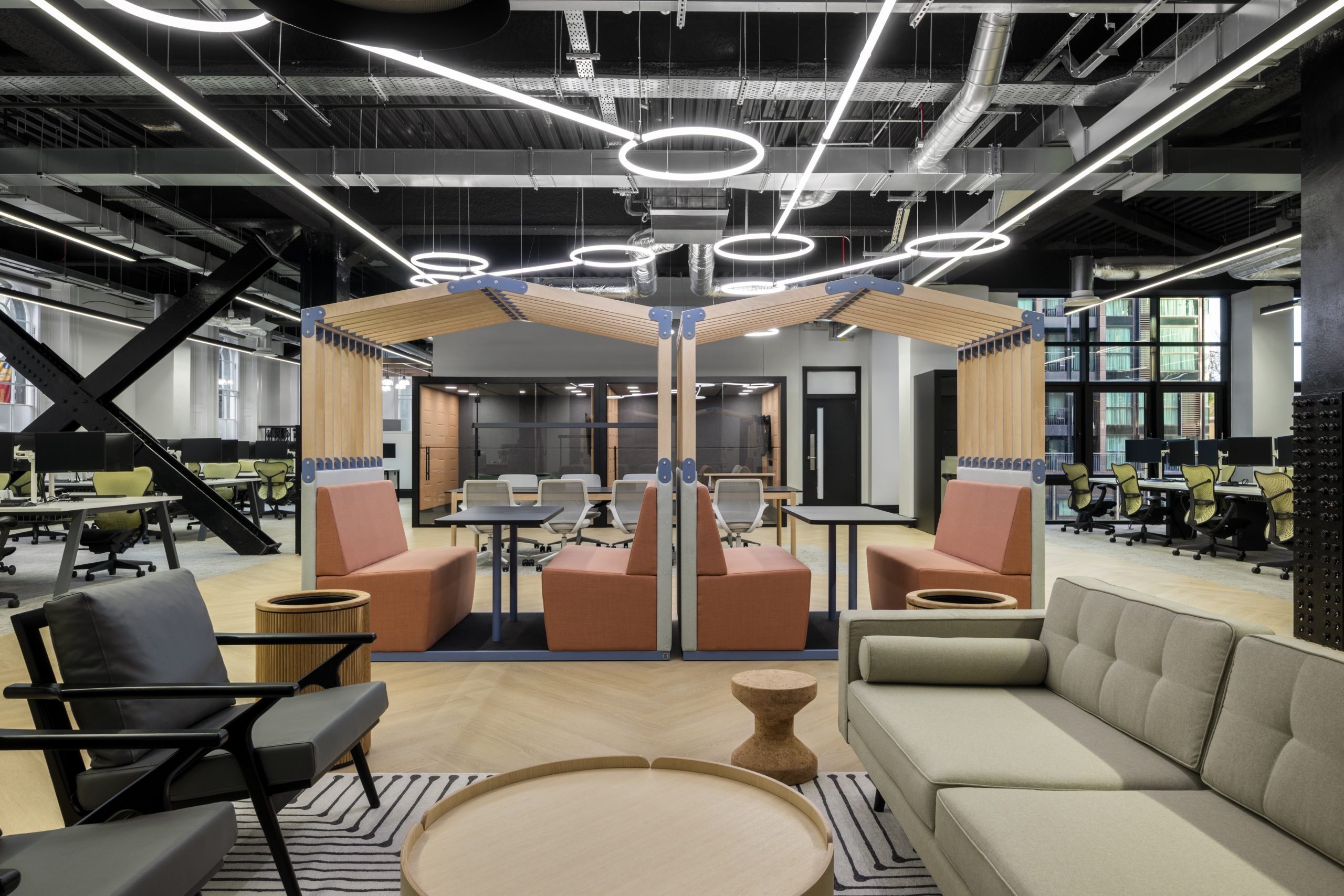
If you only read one section, read this one. FF&E stands for Furniture, Fixtures and Equipment. These are the movable items that fit out and equip your space without being built into the structure. Desks, chairs, sofas, storage, decorative lighting, screens and IT kit all count. OS&E stands for Operating Supplies and Equipment. These are typically the smaller, day-to-day items your team uses and replaces regularly; crockery, cleaning materials, stationery etc. The quickest way to tell FF&E and OS&E apart from each other comes down to lifespan and how the cost is treated. FF&E is a capital asset that lasts for years and gets depreciated. OS&E is an operating cost you expense as you buy it. Hold onto that distinction and the rest of this guide will make sense. 
FF&E stands for Furniture, Fixtures and Equipment. You will occasionally see FF&A instead, which swaps Equipment for Accessories, but FF&E is the term most of the industry contracts around. In an office context, FF&E covers the movable, non-fixed items specified to furnish and equip the workspace. It is everything you bring into the space to make it usable, as distinct from the shell you are bringing it into. FF&E is often described as everything that would fall out if you tipped a building over, and architecture being everything that stays behind. So if architecture is the skeleton of the project, FF&E is what gives the body its shape and comfort. The reception desk, the bench desking, the task chairs, the breakout sofas, the meeting room tables, the lockers, the pendant lights over the tea point, the acoustic pods and the wall art are all FF&E. The defining feature is that none of it is permanently attached to the building. You could remove it without demolition and, in most cases, take it with you when your lease ends. That mobility is the whole point. It gives you the flexibility to reconfigure, refresh or relocate as your headcount and working patterns change. FF&E breaks down into its three component parts, and it helps to look at each one.
Furniture is the most familiar category and usually the largest by value. It is anything fully movable that your team sits on, works at or stores things in. In a typical office that means desks and bench systems, task and meeting chairs, soft seating for breakout areas, coffee tables, canteen and kitchen furniture, storage units, lockers, pedestals, bookshelves and more. None of these items requires any building work to install. It arrives, it gets assembled and placed, and it can be moved again later.
Fixtures are a slightly grey area, and this is where most of the confusion creeps in. A fixture is something attached to a surface in a semi-permanent way, but not so deeply that removing it counts as structural work. Think wall-mounted shelving, fixed planters, signage, demountable partitions, secured screens and decorative light fittings hung from a ceiling point. The line to watch is this. A pendant light hanging from a junction box is FF&E. Recessed lighting wired into the ceiling grid as part of the base build is not, because it belongs to the building’s mechanical and electrical services. The same logic applies to a freestanding partition versus a structural wall. If taking it out would mean making good and patching the building, it is probably not FF&E.
Equipment covers the technology and appliances your office needs to function. Computers, monitors, screens, audiovisual kit, printers, phones, the dishwasher and fridge in the kitchen, and any specialist gear your business relies on all fall here. Some of it draws power or needs a data connection, but it is plugged in rather than wired into the structure, so it remains movable and remains FF&E. A useful real-world note for offices is that your business electronics count. The laptops, the meeting room AV and the office printer are a textbook example of the “E” in FF&E, even though people often forget to budget for them alongside the furniture. 
OS&E stands for Operating Supplies and Equipment. The term originated in hospitality, where it describes everything a hotel needs to run day to day, but the idea applies just as cleanly to an office. If FF&E is the kit your team interacts with as fixed parts of the space, OS&E is the lighter, replaceable stuff they use up while operating within it. Most OS&E needs no installation. You order it, it arrives, and it goes straight into use. In an office, OS&E includes the crockery, glassware and cutlery in the kitchen, cleaning materials and consumables, stationery and printer supplies, first aid and washroom stock, tea, coffee and other refreshments. It also includes the smaller operational gear such as a vacuum cleaner, coffee machine or a kettle. The defining trait is that these items get consumed or replaced on a rolling basis, often monthly, rather than lasting for years. Offices tend to talk about “consumables” or “office supplies” rather than OS&E, which is why the acronym feels more at home in a hotel brochure. The category is real either way, and underestimating it is a classic fit-out mistake. Teams pour attention into the furniture package and then realise, a fortnight before move-in, that nobody has costed the mugs, the cleaning contract or the milk. 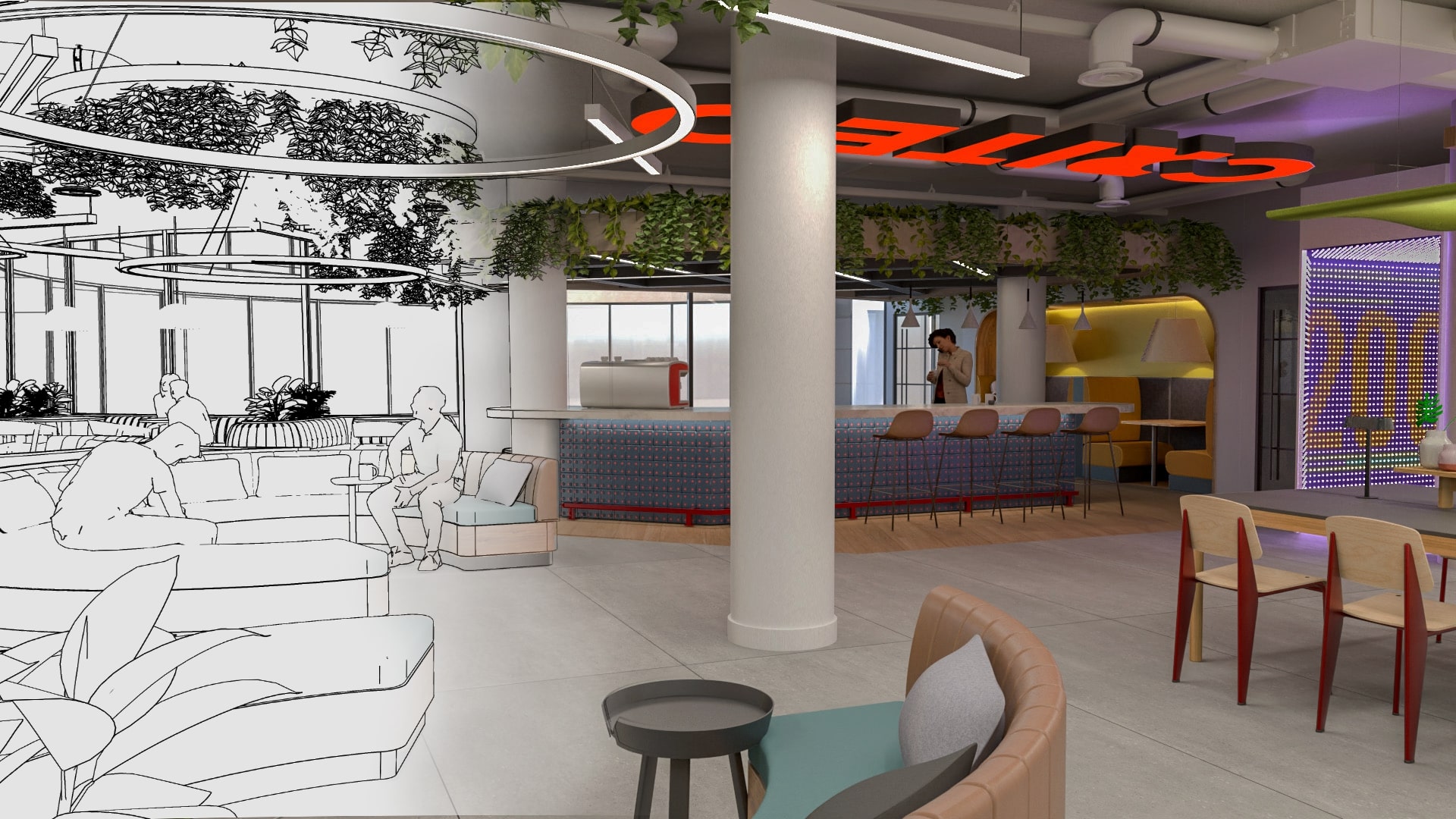
Both categories sit outside the building structure, which is why they get conflated. The differences are clear once you line them up, and they matter for budgeting, tax and project planning. The simplest distinction is lifespan and cost treatment. FF&E is a long-term capital asset, expected to serve for several years and depreciated over its useful life. OS&E is a short-term operating cost, expensed in the year you buy it and replenished constantly. Get that wrong on a budget and the numbers will not reconcile, because the two are treated differently in your accounts and by HMRC. Here is the full comparison.
| FF&E | OS&E | |
|---|---|---|
| Stands for | Furniture, Fixtures and Equipment | Operating Supplies and Equipment |
| What it is | Movable items that fit out and equip the space | Smaller items used and replaced in daily operation |
| Examples (office) | Desks, task chairs, sofas, lockers, AV, decorative lighting | Crockery, cleaning materials, stationery, refreshments |
| Lifespan | Several years, often five or more | Weeks to months, replaced regularly |
| Installation | Usually assembled and placed on site | Rarely needs installation |
| Accounting | Capitalised and depreciated as a fixed asset | Expensed as an operating cost |
| When you buy it | During the fit-out, ahead of move-in | Close to move-in and continuously afterwards |
| Budget impact | Large upfront capital outlay | Ongoing monthly running cost |
Two practical consequences follow from this table. First, the timing is different. FF&E gets specified and ordered during the fit-out, often with long lead times, and needs to be on site and installed before you move in. OS&E is ordered closer to occupation and then keeps flowing for as long as you hold the space. Apply FF&E lead times to OS&E and you will over-engineer a simple order. Apply OS&E thinking to FF&E and you will be sitting on packing crates with no chairs on day one. Second, the financial scrutiny is different. FF&E is capital expenditure that shows up on your balance sheet and gets depreciated. OS&E is operating expenditure that hits your monthly running costs. Stakeholders, finance teams and HMRC look at these two pots through different lenses, so accurate categorisation is not pedantry. It affects your reporting, your tax position and how the spend is approved in the first place. 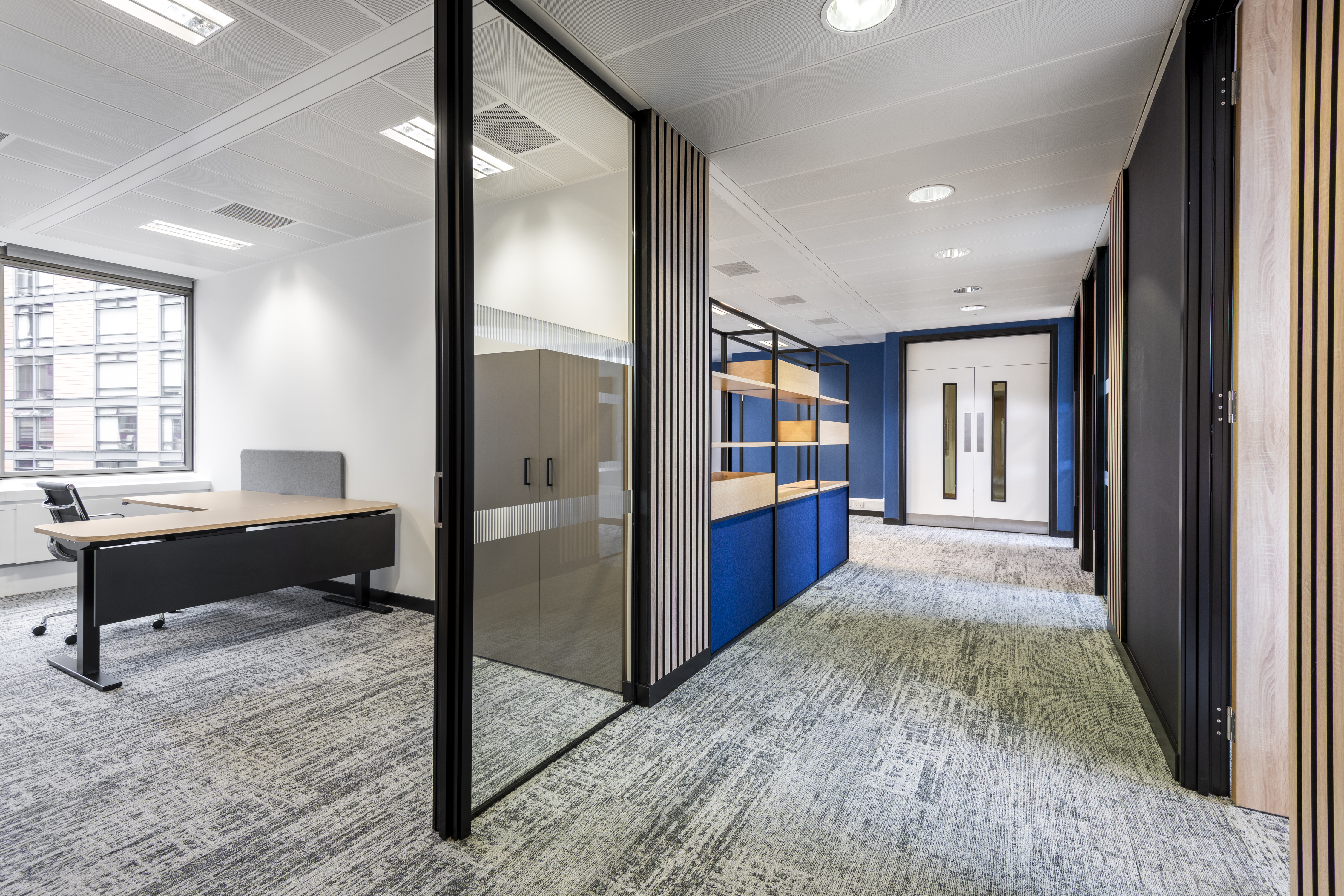
This is the office-specific version of the upside-down test, and it is worth its own section because the fit-out world has a precise vocabulary for it. Most commercial leases hand you space in one of three states. Shell and core is the bare bones: structure, cladding, lifts, stairs and the main services running to the floor, with nothing else. Category A, or Cat A, is the landlord’s basic finish to a lettable standard. That typically includes raised access floors, suspended ceilings, basic lighting, heating and cooling, and finished surfaces, but it is a blank, open-plan box with no identity. Category B, or Cat B, is your fit-out: the meeting rooms, the tea points, the partitions, the branding, the flooring and finishes that turn the box into your office. FF&E sits on top of all of this. The loose furniture package, the desks, chairs and breakout pieces, is usually procured separately again, even from the Cat B construction works, because it is movable and you may take it with you. So the rough hierarchy runs from the building, to the landlord’s Cat A finish, to your bespoke Cat B fit-out, to your FF&E, to your OS&E. Each layer is a different scope, a different budget line and, often, a different supplier. Knowing which layer an item belongs to saves real money and real arguments. Lighting is the classic example. The recessed grid lighting in a Cat A space belongs to the building. A statement pendant you hang over the reception desk is FF&E you have specified and bought. Demountable partitions can fall either way depending on how they are installed and who is paying. Pin these down early, in writing, before anyone places an order. 
People use these two words as though they mean the same thing. They do not. Purchasing is the narrow act of placing the order. It is the moment you click “buy”, agree the price and issue the purchase order. That is genuinely all it is. Procurement is the whole operation that surrounds that purchasing moment. It runs from research and specification, through sourcing and supplier negotiation, budgeting and value engineering, supply chain management, transport and logistics, project management, delivery and installation, all the way to final handover. Purchasing is one step inside that process, near the end of the first phase. If purchasing is clicking “buy now” online, procurement is everything that decides what you buy, from whom, at what price, on what timeline, and how it arrives safely on your floor in the right order. If you treat them as the same thing, you will miss lead times and discover problems on installation day rather than months earlier when they were easier to fix. 
Sourcing is the part of procurement that does the heavy lifting before any money changes hands, and it deserves a closer look because getting it right is what protects both the budget and the design. There are five things sourcing has to do well.
Purchasing is the summit of that climb. Sourcing is the climb itself, and it is by far the harder part. 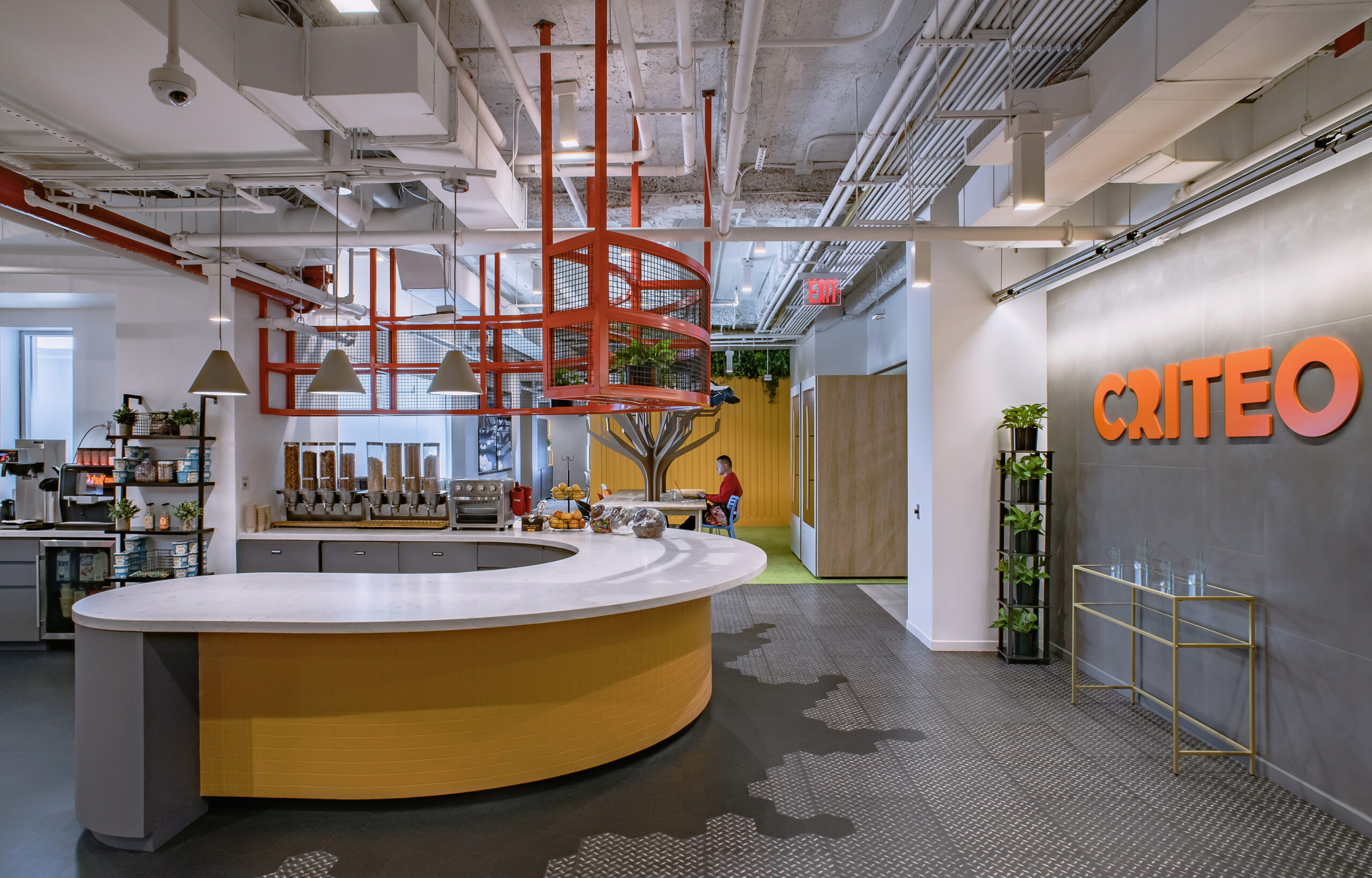
A well-run fit-out follows a clear sequence. The exact number of stages varies between firms, but the shape is consistent. Here is how the process typically runs for an office, from first conversation to handover.
The project starts by getting everyone in a room and agreeing what success looks like. This means reviewing the available information, understanding how the business actually works, and building a clear statement of requirements. A demarcation document is useful here too, setting out who is responsible for what across the client, the landlord, the contractors and the FF&E team. Ambiguity at this stage causes expensive arguments later.
With the brief agreed, the next job is a realistic cost plan. Drawing on comparable past projects, the team builds a working budget and a cash flow forecast that lines up with the wider programme. A good budget is honest about the whole picture, including freight, storage, installation and a sensible contingency, rather than just the headline price of the furniture.
Now the detail begins. The team works through the FF&E packages that make up the project, such as workstations, task seating, soft furnishings, storage, lighting and breakout pieces. For each one, they identify suppliers that hit the right quality, price and delivery requirements, keeping the design team involved at every step so the look and feel stay intact.
Value engineering is a phrase often associated with “make it cheaper…and worse”, but done properly it is the opposite. A good procurement team understands why the designer specified what they did, then uses its supplier network and buying power to find alternatives that protect the aesthetic while bringing the package back within budget. Once the choices are signed off, the tender packages get built and the tender process runs.
This is the stage where orders are actually placed. It covers the final negotiations with suppliers, agreeing terms and conditions, issuing purchase orders and tracking deliveries. The earlier sourcing work is what makes this step go smoothly, because the hard decisions have already been made.
Money needs visibility. Working with cloud-based, real-time reporting means you can see exactly where the budget stands and what assets you are accumulating at any point. Clean financial coding here also makes the next year’s accounting and capital allowances claim far easier, which is a point we will come back to.
Getting the right items to site, on budget and on time, is the whole point of the exercise. This stage covers transport planning, insurance, storage and inventory management, and the careful sequencing of deliveries so that the floor does not fill up with boxes before anyone is ready to install them.
Installation is where the planning pays off. A dedicated team assembles, positions and inspects every item, snagging anything that is damaged or wrong and putting it right. Final handover then pulls together the documentation: the health and safety file, the operation and maintenance manuals, warranties and asset schedules. Done well, you walk into a finished, working office with a full record of everything in it. 
This is where FF&E stops being a design term and becomes a finance one, and where the UK rules differ sharply from the American guidance you will find on most websites. The following is general information rather than tax advice, so check the specifics with your accountant. The principles, though, are worth understanding before you sign off a fit-out budget. FF&E is a tangible fixed asset. It adds value to the business and, because most items have a useful life of several years, it is capitalised and depreciated in your accounts rather than written off in one go. OS&E, by contrast, is expensed as an operating cost in the year you buy it. But there’s a catch. The depreciation you show in your accounts is not the same as the tax relief you receive. HMRC does not let you simply deduct accounting depreciation from your taxable profits. Instead, tax relief on FF&E comes through capital allowances, which follow their own rules. For most businesses the headline points are these. Office furniture, fittings and computer equipment count as plant and machinery, which qualifies for the Annual Investment Allowance. The AIA lets you deduct the full cost of qualifying expenditure, up to a limit of £1 million a year, in the year of purchase. Companies subject to corporation tax can also use full expensing, a 100% first-year allowance on new and unused main-pool plant and machinery, including office furniture and IT. Either way, a large slice of a fit-out’s FF&E can often be relieved against profits straight away rather than dripped out over years. Where spend exceeds those allowances, the remainder falls into one of two pools. The main pool attracts an 18% writing down allowance each year on a reducing balance. The special rate pool, which covers integral features such as air conditioning, electrical systems and certain lighting, attracts 6% a year. This is why categorising a fit-out accurately matters so much. Items lumped into the wrong category, or buried in a contractor’s single-line invoice, can end up relieved far more slowly than they should be, or missed altogether. A simplified office example shows the upside. Suppose a company spends £60,000 on new office furniture and IT as part of a fit-out. Because these qualify as main-pool plant and machinery, the business can typically claim the full £60,000 against its taxable profits in the year of purchase under the AIA or full expensing, rather than spreading the relief across several years. The cash flow benefit of pulling that relief forward is significant, which is one reason finance teams care about when a fit-out completes relative to their year end. Two habits make all of this easier. Keep an itemised FF&E schedule with clear costs from order to installation, because HMRC has been known to ask for the underlying detail behind expenditure coded as fixtures and fittings. And get the categorisation right at the point of purchase rather than trying to reconstruct it from memory two years later. 
FF&E procurement is not something you want to take on alone, and the savings from going direct tend to be a mirage. The case for a partner only gets stronger the closer you look at how furniture actually reaches a UK office floor. Start with the suppliers. FF&E specification runs to hundreds of them, each with their own ranges and lead times, and a commercial interest in selling you as much of their own product as they can, whether or not it suits your brief or your budget. Go direct and you deal with every one of them separately. You also rarely buy at the rate a specialist commands, because you are placing a single order where they place hundreds across many projects. Then there is the question of getting the furniture here at all. A good deal of contract furniture is manufactured in Europe, and since Brexit that route carries more friction than it once did. There is customs paperwork to clear and rules of origin to evidence, and the odd consignment gets held at the border. All of it adds time, and it adds that time to lead times that run long to begin with. A bespoke piece or an imported range can take several months to land, and installation week is a painful moment to learn that for the first time. The day-to-day reality of going direct is a lot of chasing. You confirm delivery dates with a dozen different suppliers, then re-read every line of every order so nothing slips through, only to learn that the chair you specified has gone out of stock with no obvious replacement. A specialist partner takes that weight off you. The contrast is easiest to see side by side.
| Going direct | Working with an FF&E partner | |
|---|---|---|
| Pricing | One-off orders, usually at or near list price | Trade rates earned by buying across many projects |
| Supplier management | You deal with every supplier yourself | One contact runs the whole supply chain |
| Lead times | Easy to underestimate, often found out too late | Built into the programme from day one |
| European and imported furniture | You handle the customs and import admin yourself | Import logistics and clearance are managed for you |
| Logistics and storage | Boxes arrive whenever they happen to arrive | Deliveries sequenced, stored off site and installed in order |
| Order accuracy | Every line is yours to check and re-check | Specifications cross-checked before any order is placed |
| When an item is unavailable | You go back to the drawing board | A like-for-like alternative offered quickly |
| If something goes wrong | Suppliers point at each other | One party is accountable for the whole package |
Getting FF&E right is a lot easier with people who do it every day. If you have a fit-out on the horizon, or you are simply weighing up whether to handle the furniture package yourself, our team would be glad to talk it through and show you how we would approach it. You can see how we work, and what the service covers, on our FF&E procurement page.