
Lease event on the horizon?

Find out how much space you need before you commit. Our workplace consultancy usually takes four to eight weeks.

Dentsu Edinburgh office: timber-framed meeting pods beside the open-plan desks, as built
Knowledge / Guidance

/ What is workplace consultancy, and when do you need it?

What is workplace consultancy, and when do you need it?

A plain-English guide to what workplace consultancy involves, the signs you need it and how to get the timing right before a lease event or fit-out.

Share
Summarise
Greg DooleyMarketing ManagerDesign and Build Content Specialist.

Greg Dooley - Marketing Manager

In Brief

  • Workplace consultancy measures how your office is really used and turns that evidence into a brief for your next lease, move or refurbishment.
  • The best time to start is 18 to 24 months before a lease event, while every option is still open.
  • A typical engagement takes four to eight weeks and ends with a workplace strategy you own outright.
  • You can buy it on its own and take the strategy to any designer or fit-out contractor.

What workplace consultancy means

Workplace consultancy is the work of finding out how your people use your office today, what they need from it, and what that means for the space you should have next. It sits before design. The output is a set of decisions about how much space you need and how it should be laid out and furnished.

The term has a second meaning. In HR, “workplace consultancy” often refers to workplace investigations, mediation and employee relations advice. This article is about the property and office-strategy sense: your office space and the way people work in it.

Most businesses only think about their office properly when something forces the issue. A lease break or a hybrid policy that has drifted both raise the same question. Do we have the right space, and how would we know? Workplace consultancy gives you an answer based on evidence rather than opinion.
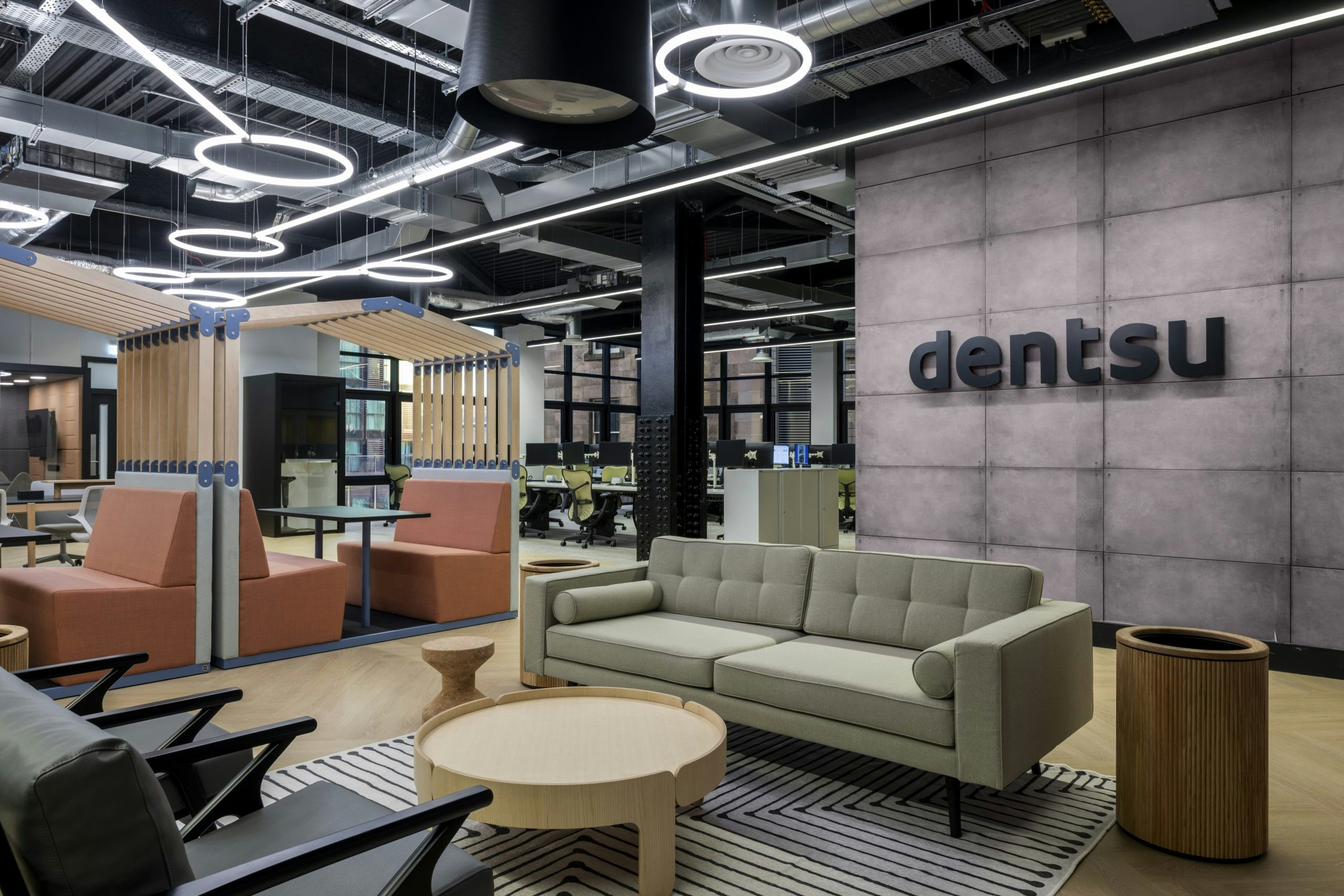
Dentsu office lounge with sofa and coffee table beside the illuminated Dentsu logo wall

What a workplace consultancy engagement involves

A good engagement combines hard data about how the space is used with what your people tell you. At K2 Space, workplace consultancy covers four strands.

Space utilisation analysis

This is the measurement. An occupancy study records how each zone is used, at what time of day the peaks fall, and how actual use compares with what the space was planned for. It is often the part that surprises leadership teams. Across the market, the XY Sense Workplace Utilization Index shows 25% of desks go completely unused on a given day and 65% are occupied for under three hours.

Employee engagement

Data shows what people do. It does not show why. Surveys and workshops fill that gap by asking staff what helps them do their best work and what keeps them at home. On PJT Partners’ 48,000 sq ft Mayfair office, stakeholder workshops showed that community spaces and premium finishes would bring people back more effectively than attendance mandates.

Ways-of-working review

This looks at how teams actually operate: which groups need to sit together, how much focused work happens versus collaboration, and whether the hybrid policy matches what people do. At Dentsu’s office in The Stamp Office, Edinburgh, a ways-of-working review led to the “One Dentsu” concept that shaped the whole project.

Workplace strategy

The final strand pulls everything together into a strategy that becomes the brief. It sets desk-to-person ratios, zoning and adjacencies, and the furniture specification. It is the document your designers, your landlord’s agents and your finance director can all work from.

K2 team working together
Stakeholder workshop at K2
K2 team collaborating on an office design project
Testing ideas with a client team

Signs you need workplace consultancy

You do not need a consultant every year. These are the situations where the cost of getting the space wrong is high enough to justify one.

  • A lease event in the next 18 to 24 months. A break clause, an expiry or a rent review is the point where you can change your space. Starting this early gives you time to weigh staying against moving, and to negotiate from evidence. Our guide on staying versus relocating covers that decision in more detail.
  • Hybrid attendance has changed. If your policy has moved, or the reality has drifted away from the policy, the space you planned in 2021 is unlikely to fit. UK office occupancy hit a post-pandemic record of 44.1% in late January 2026 (Remit Consulting), so attendance patterns are still shifting.
  • Meeting rooms sit empty while breakout is full. This is one of the clearest signs of a mismatch. XY Sense found that 94% of meetings involve six people or fewer and 68% involve just one or two. A floor full of eight-person boardrooms is often the wrong answer.
  • Headcount is changing. Growth or a restructure changes how much space you need and how teams should sit. Savills reports that 55% of Central London occupiers are looking to increase their footprint, which makes good space harder to secure late.
  • The board wants a business case. If someone has asked “why do we need this much space?” or “what will a move give us?”, you need numbers you can stand behind. A utilisation study and a written strategy give the board something to test.
Mike Walley, Workplace Intelligence at K2 Space

Lease event in the next two years?

Our workplace consultancy is led by Mike Walley, who spent 25 years running workplaces for global technology companies. A first conversation will tell you whether a review is worth doing before you commit to space.

What you get at the end

The main output is a workplace strategy document. It should tell you how much space you need, how many desks per person, which teams sit where, what mix of settings to provide and what furniture to specify. It should also show the evidence behind each recommendation so the decisions survive scrutiny.

In practice, that document does three jobs. It gives your agent a clear requirement when searching for space. It gives your designer a tested brief, which means fewer changes once design starts. It also gives your finance team a basis for budgeting, because the size and specification of the fit-out are settled earlier.

Because K2 also designs, builds and furnishes offices, the strategy can carry straight on into space planning, design and costings with the same team, so nothing is lost between the people who studied your workplace and the people who build it.

How long workplace consultancy takes

A typical engagement runs four to eight weeks. A single-floor office with one team can be assessed at the shorter end. Multi-floor or multi-site organisations need more time for data collection and stakeholder sessions. Focused reviews of a single floor or team can be shorter.

The occupancy study needs to cover representative weeks, so avoid school holidays, August and the run-up to Christmas if you can. Build that into your timeline if a lease date is fixed. Working backwards from a lease event, a sensible plan allows two months for consultancy, then time for space search or negotiation, design and the fit-out itself.

US hedge fund - London Mayfair - Technologically Equipped Spaces for Team Meetings
Team meeting space, US hedge fund, Mayfair
Individual Focus Rooms Bordering a Collaboration Area
Focus rooms beside a collaboration area, Mayfair
PJT Office Fit Out London - LARGE-36
Café and lounge, PJT Partners, One Curzon Street

Standalone or leading into design and build

You can buy workplace consultancy on its own. The strategy is yours, and you can take it to any designer, fit-out contractor or internal facilities team. Some organisations use it purely to inform a lease negotiation or to settle an internal debate about hybrid working.

Many clients carry on into design and build with the same team. The advantage is continuity. The people who ran the workshops and read the occupancy data are the ones turning it into a layout, so less is lost at each handover. If you are planning a move or refurbishment, it is worth seeing how consultancy feeds into an office fit-out in London before you decide.

Either route is valid. The important thing is that the strategy comes before the design, not after it.

How to choose a workplace strategy consultant

Workplace strategy consultants come from different backgrounds: property advisers, architects, design and build firms and independent specialists. Each will bring a different bias. These questions help you compare them.

  • Who will do the work? Ask to meet the person who will run your workshops and interpret your data, not only the person who pitches.
  • Have they run a workplace themselves? Advice from someone who has managed offices day to day tends to be more practical about what works once people move in.
  • How do they measure utilisation? Ask how long the study runs, how they handle hybrid patterns and whether they compare planned use with actual use.
  • Is the strategy yours to keep? You should be free to take it to any provider without being locked into one supplier.
  • Do they understand what is buildable? A strategy that ignores cost, building constraints or furniture lead times will need rework later.
  • Can they show relevant work? Look for projects of a similar size and sector, and ask what changed as a result of the consultancy.

At K2, workplace consultancy is led by Mike Walley, who spent 25 years creating and running workplaces around the world for global technology companies. That client-side experience shapes the advice: it is grounded in how offices operate after the designers have left. Because K2 also designs, builds and furnishes offices, recommendations are tested against what is buildable and affordable. K2 works with organisations from 20 to more than 2,000 people.

PJT Office Fit Out London - LARGE-33

Talk to us early

The earlier you start, the more options you keep. If you have a lease event on the horizon or a board asking hard questions about space, a short conversation will tell you whether workplace consultancy is the right next step.

Read more about our workplace consultancy service, or request a callback and we will arrange a time to talk it through.

Frequently asked questions

What does a workplace consultant do?

A workplace consultant measures how your office is used, gathers views from your people and leadership, and turns the evidence into a workplace strategy that becomes the brief for your next lease, move or refurbishment.

How long does workplace consultancy take?

A typical engagement takes four to eight weeks. Focused reviews of a single floor or team can be shorter.

When should I start workplace consultancy?

Ideally 18 to 24 months before a lease break, expiry or planned move, while every option is still open.

Can I use the strategy with another designer or contractor?

Yes. The strategy is yours to keep and can be taken to any designer, fit-out contractor or internal facilities team.

PJT Office Fit Out London - LARGE-39

Find out how your office is really used

We measure occupancy, talk to your people and give you a workplace strategy you own. A typical engagement takes four to eight weeks and can be bought on its own.

Latest Knowledge