Share
Summarise


/ Smart Office Technology 2026
The global smart office market is expected to grow from roughly $61 billion in 2025 to $69 billion in 2026, and it will more than double again before the end of the decade. Yet most organisations still approach workplace technology as an afterthought, bolting on sensors and booking apps long after the fit-out is complete. The organisations getting the strongest returns are those that treat technology as a design discipline, specifying it alongside lighting, acoustics, and furniture from the very first briefing meeting.
Smart office technology is the collective term for the sensors, software platforms, and automated building systems that make a workspace aware of how it is being used and enable those using it to respond in real time. That might mean lighting that adjusts to natural daylight levels, meeting rooms that release themselves when no one shows up, or HVAC systems that direct heating and cooling only to occupied zones. The common thread is data: these technologies collect it, analyse it, and act on it without waiting for someone to manually flick a switch or file a facilities request.
A smart office is a workspace where those technologies are integrated into the fabric of the building rather than bolted on as afterthoughts. Interconnected sensors feed data to centralised platforms, which in turn adjust environmental conditions, manage space allocation, and reduce energy waste without constant human intervention.
The purpose is not surveillance or novelty. It is to make the building genuinely responsive to the people inside it. When these systems are specified properly during an office fit-out, they become invisible infrastructure that quietly makes everything else work better. For organisations considering a refurbishment or relocation, the timing matters.
Retrofitting smart systems into a completed workspace is considerably more expensive than specifying them during the design phase. Cabling routes, sensor positions, network architecture, and integration with mechanical and electrical services all benefit from being planned alongside the interior design rather than layered on top of it.
The most effective smart offices are not the ones with the most gadgets. They are the ones where technology has been coordinated with the spatial design from day one. This guide examines the smart office technologies that are delivering measurable value in 2026, separates the proven from the speculative, and explains how to build technology readiness into a workplace project so that systems can evolve as needs change.

The first wave of smart office adoption was driven by property managers and facilities teams looking to reduce operating costs. Sensors monitored whether lights were on, whether rooms were occupied, and whether air conditioning was running in empty zones. The data flowed into dashboards that helped building operators make better decisions. The occupants themselves rarely noticed.
What has shifted in 2026 is the direction of value. Technology is now oriented toward the people who use the space, not just the people who manage it. Employee experience has become the primary design objective, with operational efficiency treated as a welcome by-product rather than the sole justification. Industry analysts at UC Today describe this as a move from treating technology as a cost-reduction exercise to treating it as an investment in people. Organisations that frame smart office spending in these terms tend to achieve broader adoption, because employees engage with systems that visibly benefit them.
A second change is the shift from passive monitoring to active environmental management. Early systems recorded what was happening. Current systems respond to what is happening in real time, adjusting lighting, ventilation, and temperature zone by zone as occupancy patterns change throughout the day. This transition has been accelerated by the falling cost of IoT sensors, the maturity of cloud-based analytics platforms, and the growing availability of AI models capable of learning from building data. Industry surveys show that over 90 per cent of organisations now invest in some form of smart building system, with the largest share of spending directed toward HVAC, electrical, and lighting integration.
The third change is integration. Historically, desk booking software sat in one silo, the building management system in another, and the conferencing platform in a third. Each had its own dashboard, its own data set, and its own vendor relationship. The direction of travel in 2026 is toward unified workplace platforms that connect previously separate systems into a single intelligent layer. When a meeting room booking is cancelled, the lighting dims and the ventilation drops to standby. When occupancy on a floor exceeds a threshold, wayfinding screens redirect people to quieter zones. These cross-system responses are only possible when technology is designed as an integrated ecosystem rather than a collection of point purchases.
For organisations planning a new office design, understanding this evolution matters. The question is no longer whether to include smart technology, but how deeply to embed it into the fabric of the workplace.
If there is a single technology that has reshaped how organisations think about their workplaces, it is the occupancy sensor. The data these devices produce has changed real estate decisions, informed fit-out briefs, and exposed a persistent gap between how organisations think their space is used and how it is actually used.
The principle is straightforward. Small, wireless sensors installed on desks, in meeting rooms, and at entry points detect whether spaces are occupied in real time. The data feeds into analytics platforms that produce utilisation heat maps, peak-demand curves, and trend reports over weeks and months. What consistently emerges is that actual utilisation is far lower than expected. Research from CBRE confirms that the vast majority of occupiers now measure space utilisation, with badge-swipe data being the most common method and over half of organisations planning to add sensor or Wi-Fi based analytics by 2026. The findings are often sobering. Studies consistently show that desk utilisation rates run 40 to 60 per cent lower than facilities teams assumed, and that meeting rooms are frequently booked but left empty, a phenomenon widely known as “ghost bookings”.
For organisations approaching a space planning exercise, this data is transformational. Rather than designing around headcount alone, designers can work with actual demand patterns. The result is typically a smaller, better-configured floor plate with a wider variety of settings, from quiet focus zones to collaborative team areas, rather than row after row of permanently assigned desks. Sensor data from comparable projects suggests that organisations using occupancy analytics can reduce their space costs by 20 to 35 per cent while simultaneously improving the quality and variety of the settings on offer.
Privacy is a valid concern, and the most reputable sensor technologies address it directly. Modern occupancy sensors do not use cameras, do not capture personal data, and do not identify individuals. They detect presence through infrared, thermal, or wireless signal detection, providing anonymous counts rather than named records. This distinction matters when communicating the system to employees. Organisations that are transparent about what sensors do and do not capture build trust. Those that install them without explanation risk the opposite.
The connection to hybrid working is direct. When desk provision has dropped and mid-week peaks create pressure on space, real-time occupancy data ensures the right settings are available to the people who need them. It also informs longer-term decisions about lease renewals, floor consolidation, and whether additional breakout or collaboration space is needed.
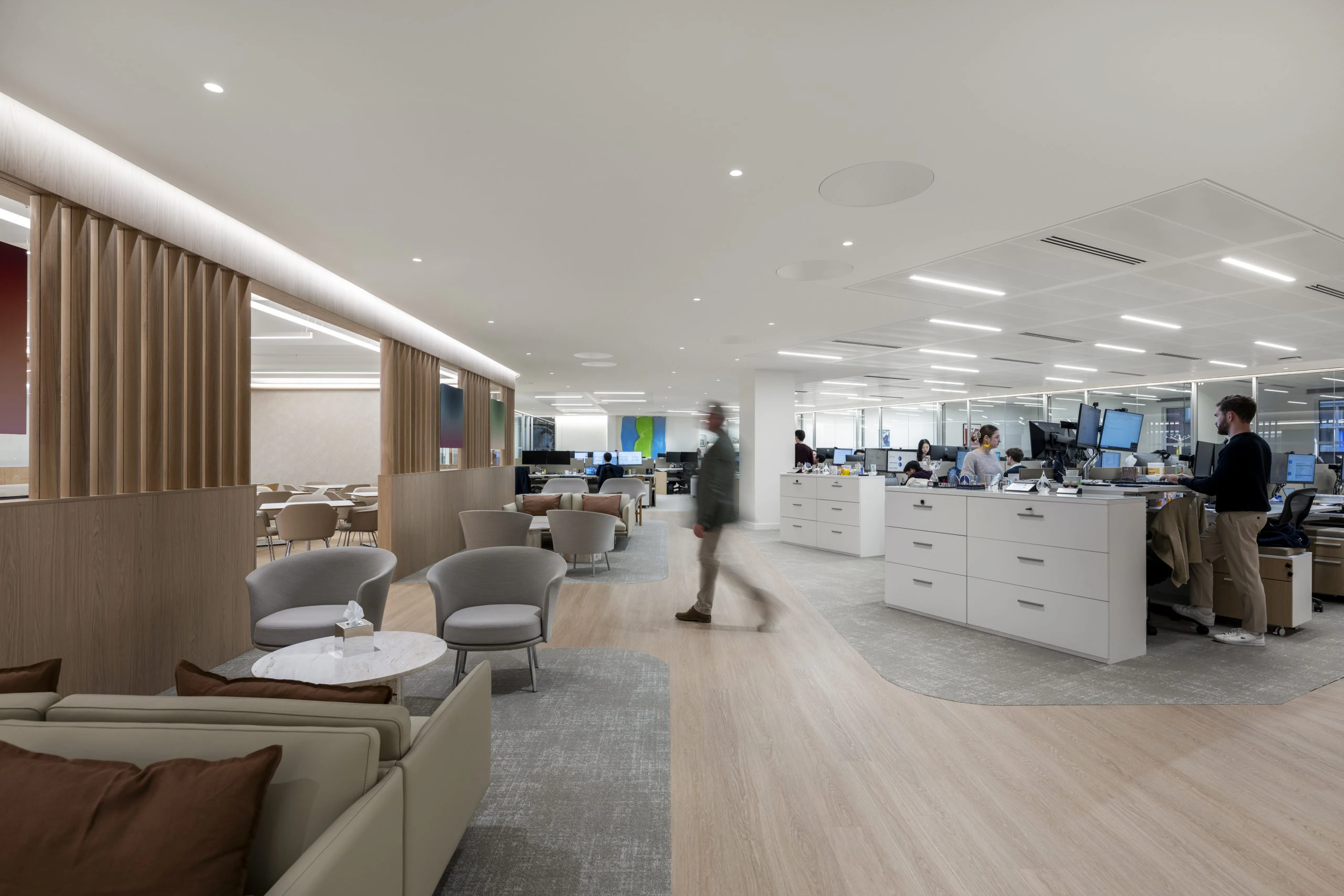
Heating, ventilation, and air conditioning account for approximately 40 to 60 per cent of a commercial building’s total energy consumption. In a market where energy prices remain volatile and ESG reporting requirements continue to tighten, intelligent HVAC control is no longer a premium upgrade. It is a financial and environmental baseline.
A smart HVAC system uses data from temperature sensors, CO2 monitors, humidity gauges, and occupancy detectors to adjust heating and cooling zone by zone, in real time, based on who is actually in the building and what conditions they need. Rather than running a uniform climate across an entire floor regardless of how many people are present, the system responds to actual demand. When a zone empties after lunch, the system reduces output. When a meeting room fills to capacity, ventilation increases to maintain indoor air quality and comfort. Research from Lawrence Berkeley National Laboratory has found that buildings using analytics-driven controls can reduce their energy consumption by as much as 50 per cent.
For organisations pursuing BREEAM, LEED, or NABERS UK certification, smart HVAC provides both the performance data and the operational efficiency that assessors require. The ability to demonstrate real-time monitoring, demand-based ventilation, and measurable reductions in energy intensity strengthens the case considerably. It also reduces ongoing operating costs, which for many London occupiers represents the second-largest line item after rent itself.
The design implications are worth noting. Effective smart HVAC depends on proper zoning during the fit-out. If the mechanical design treats the entire floor as a single control zone, no amount of software intelligence will allow granular adjustment. Specifying multiple zones during design, aligned with anticipated usage patterns (open desks, enclosed meeting rooms, breakout areas, focus booths), gives the technology something useful to control. This is precisely the kind of coordination that benefits from a design-and-build approach, where the technology consultant, the M&E engineer, and the interior designer are working from the same brief.
Integration with smart lighting and occupancy sensors amplifies the savings. When all three systems share data, the building responds as a coordinated whole rather than three separate systems making independent decisions.
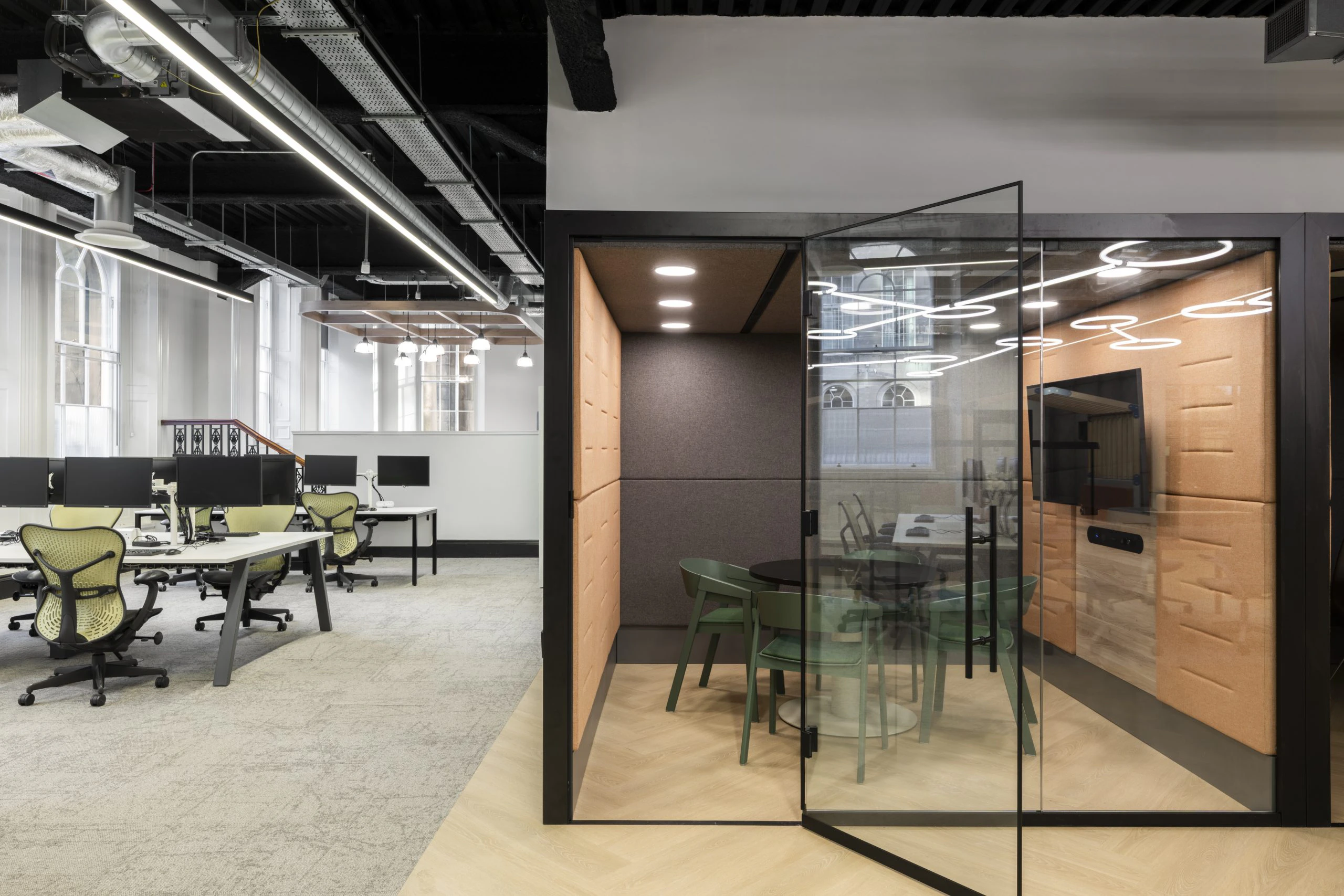
Lighting accounts for roughly 15 to 20 per cent of a commercial building’s electricity consumption, and it is one of the easiest systems to optimise through automation. Yet the value of smart lighting in 2026 extends well beyond energy savings. It is now a core contributor to employee wellbeing, concentration, and circadian regulation.
A smart lighting system combines LED fixtures with occupancy sensors, daylight sensors, and programmable controls. At the basic level, lights switch on when someone enters a zone and switch off when the last person leaves. At a more sophisticated level, the system adjusts colour temperature throughout the day, shifting from cooler, bluer tones in the morning (which promote alertness) to warmer tones in the afternoon (which reduce eye strain and support the body’s natural circadian rhythm). This approach, often described as human-centric lighting, is supported by a growing body of evidence linking lighting conditions to cognitive performance and comfort.
Daylight sensors add a further layer. When natural light levels are high, the system dims artificial lighting to maintain a consistent lux level without waste. Combined with motorised blinds, this coordination can reduce lighting energy consumption by 20 to 40 per cent in large commercial buildings. The DesignLights Consortium’s NLC-HVAC Integration Toolkit, widely adopted across the industry, demonstrates that coordinating networked lighting controls with HVAC systems can deliver whole-building energy savings exceeding 20 per cent.
For workplace design in 2026, the specification of lighting goes far beyond choosing fixtures. It involves designing a control architecture that is zoned by activity type, integrated with the building management system, and capable of being tuned after handover as usage patterns become clearer. The cabling and network infrastructure for this system needs to be specified during the fit-out, not retrospectively.
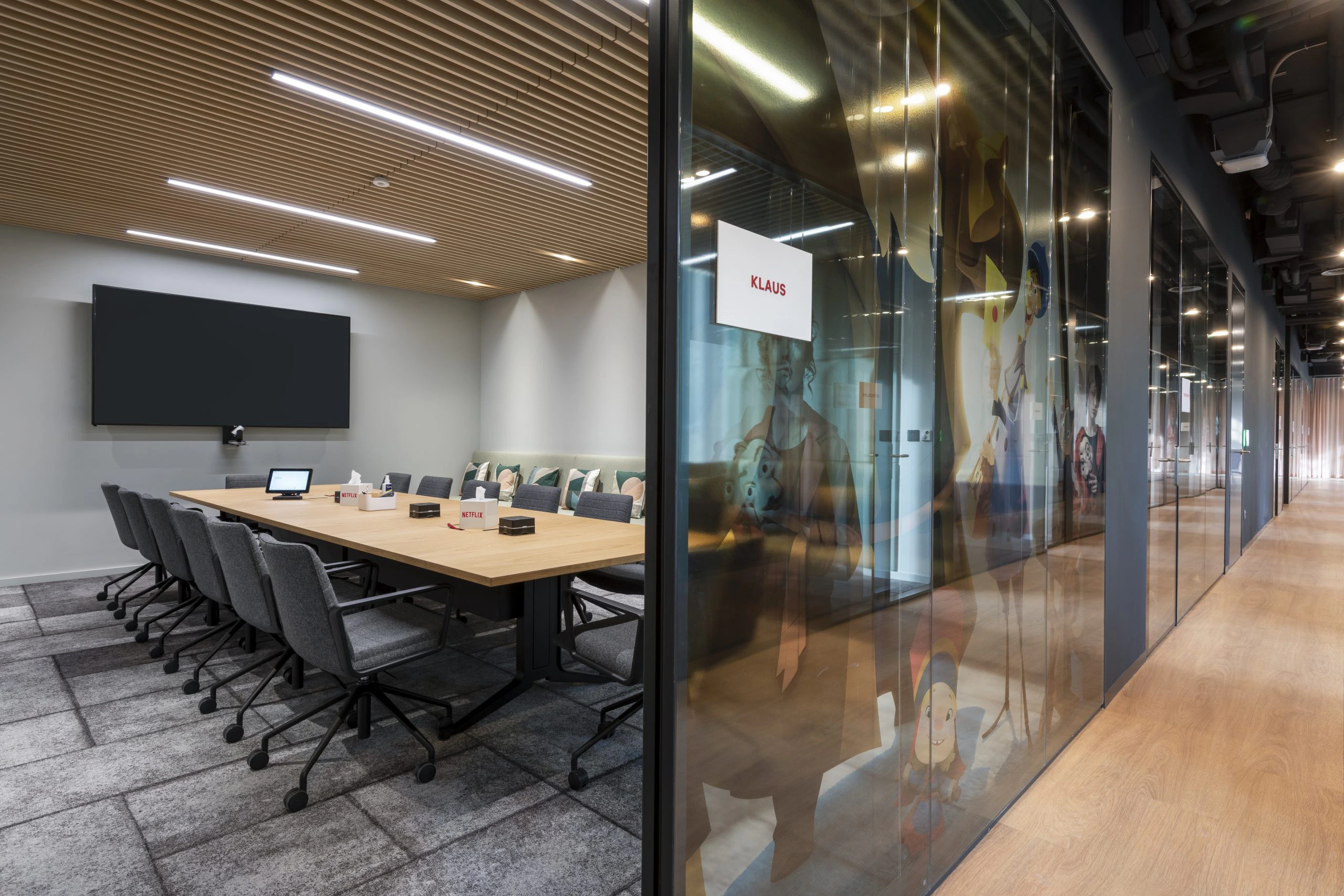
The shift to hybrid working has made desk and room booking systems a visible, daily touchpoint for employees. More than any other smart office technology, booking platforms shape how people experience the workplace on a practical level. A poorly implemented system creates friction, confusion, and wasted journeys to the office. A well-designed one provides confidence that the right space will be available, for the right purpose, at the right time.
The category has matured rapidly. Platforms now combine desk reservation, meeting room scheduling, visitor management, and space analytics in a single interface. Integration with Microsoft 365, Google Workspace, Slack, and Teams means employees can book a desk or a room without leaving the tools they already use. AI-assisted features recommend rooms based on meeting size, attendee location within the building, and available AV equipment. Auto-release functions free up rooms that are booked but unoccupied after a set period, directly addressing the ghost-booking problem that wastes an estimated 25 to 45 per cent of meeting room capacity in many organisations.
The data these systems generate is as valuable as the booking function itself. Utilisation dashboards show which rooms are overbooked, which are consistently empty, which desk neighbourhoods are most popular, and at what times of the week demand peaks. For organisations reviewing their space plan, this data replaces guesswork with evidence. It also helps justify design decisions to leadership, boards, and finance teams.
From a fit-out perspective, booking systems need physical infrastructure to function well. Room panels displaying live availability outside meeting rooms, QR or NFC check-in points at desks, wayfinding screens at lift lobbies, and reliable Wi-Fi coverage throughout the floor all need to be specified and installed during the project. Retrofitting these elements after handover is possible but more disruptive and more expensive.
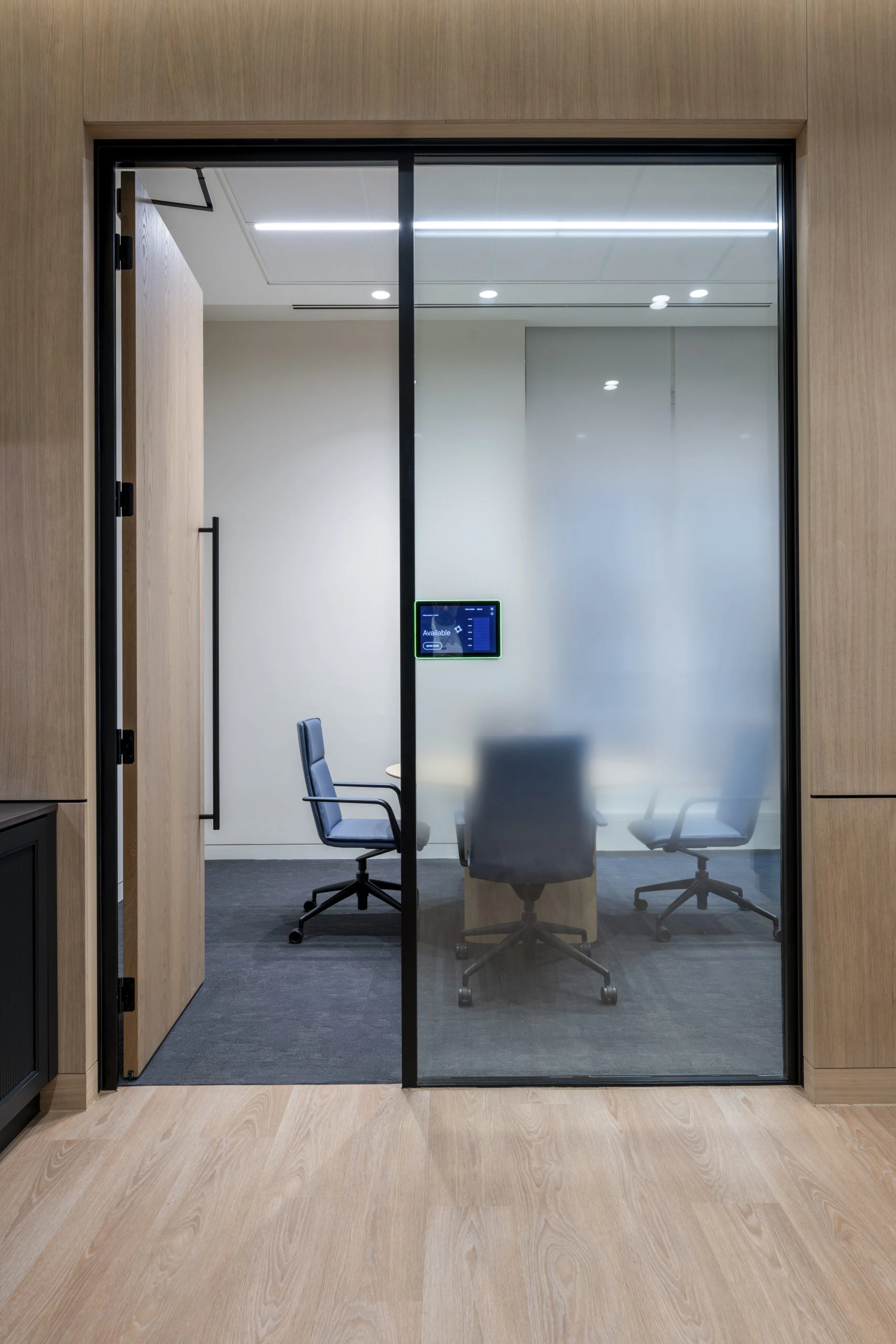
The standard of audio-visual technology in the workplace has risen sharply since hybrid working became permanent. Employees who split their time between home and office expect meeting technology that works first time, every time, with no fiddling, no buffering, and no awkward moments where the remote participant is ignored. The concept of meeting equity, where everyone in a meeting can contribute equally regardless of location, has become a defining expectation for AV specification in 2026.
Achieving meeting equity requires more than a webcam and a soundbar. It involves intelligent camera systems that track the active speaker or frame all in-room participants equally, directional microphone arrays that capture voices clearly without picking up background noise, and displays large enough for remote participants to be seen at a natural scale. AI-powered video platforms now adjust framing automatically, switching between speaker view and gallery view based on the flow of the conversation, without anyone pressing a button.
For boardroom and meeting room design, the AV specification has a direct influence on room geometry, acoustic treatment, lighting design, and furniture layout. Camera placement affects sightlines. Microphone coverage determines table shape and size. Screen position affects where participants sit relative to natural light. These dependencies mean that AV cannot be treated as an afterthought to be installed once the room is built. It must be part of the initial room design.
The growing use of smart whiteboards and interactive displays adds a further layer. Modern panels offer 4K resolution, ambient light adjustment, and direct integration with conferencing platforms. Content shared on screen during a meeting is automatically captured and distributed, reducing the need for manual note-taking and keeping remote participants fully engaged.
Quality conferencing technology is now a baseline expectation for professional services firms, financial institutions, and technology companies. In many of the projects K2 Space has delivered for clients in these sectors, the AV specification has been a primary driver of room design rather than a secondary fit-out item.
A digital twin is a real-time virtual model of a physical building that mirrors its systems, conditions, and performance. Unlike a static BIM model, which represents how a building was designed, a digital twin reflects how it is actually operating right now. It is a living, continuously updated representation fed by data from IoT sensors, building management systems, and occupancy platforms.
The practical value of digital twins in commercial offices is becoming clearer as the technology matures. Property managers and facilities teams use them to visualise energy flows, identify equipment faults before they cause failures, and simulate the impact of changes before implementing them. If a client is considering converting an underused floor into co-working space, the digital twin can model how the change would affect HVAC load, lift traffic, and power distribution before a single partition is moved. Autodesk, one of the leading providers, describes the concept as giving owners “multi-dimensional views into how an asset is performing, including occupant behaviour, use patterns, space utilisation, and traffic patterns.”
The operational benefits are tangible. Predictive maintenance, enabled by continuous monitoring of equipment vibration, temperature, and runtime, can identify a failing component days or weeks before it causes a disruption. This reduces downtime, extends equipment life, and avoids the cost and disruption of emergency repairs. For organisations occupying premium London office space, where any interruption to building services has an outsized impact on productivity, this capability represents genuine value.
Digital twins also strengthen ESG reporting by providing auditable, real-time data on energy consumption, carbon emissions, and environmental conditions. Rather than relying on estimates or annual utility bills, organisations can report with precision and demonstrate continuous improvement.
The technology is most effective when the twin is created during the fit-out process, using BIM data from the design phase as the starting point. Retrofitting a digital twin onto a building with poor documentation is possible but more complex and more costly.
Every smart device added to a building expands the attack surface available to malicious actors. As offices deploy more IoT sensors, cloud-connected platforms, and wireless access points, the cybersecurity implications grow in direct proportion. The most common vulnerabilities are mundane rather than exotic: default passwords left unchanged, outdated firmware on connected devices, and inconsistent access controls across multiple platforms.
Industry data shows that stolen credentials remain a factor in the vast majority of breaches involving web applications, underscoring the importance of identity-first security. Multi-factor authentication, single sign-on, and role-based access controls are no longer optional extras. They are foundational requirements for any smart office deployment. Zero-trust security models, which verify every user and device before granting access to any resource, are becoming the standard approach for organisations managing sensitive data in connected workplaces.
For organisations in financial services, legal, and professional services, the cybersecurity architecture of the smart office is a board-level concern. Regulators expect appropriate technical and organisational measures to protect data, and the reputational cost of a breach far exceeds the cost of proper security design.
From a fit-out perspective, the network architecture is as important as the interior design. Structured cabling, segmented networks that isolate IoT traffic from corporate data, enterprise-grade Wi-Fi with sufficient density for full-floor coverage, and a managed firewall are all elements that need to be specified during the project. During its work with KKR and other financial services clients, K2 Space has coordinated closely with client IT teams to ensure that technology infrastructure meets both operational and security requirements from the outset.
Smart office technology generates data about how people use space, when they arrive, where they sit, and how they move through the building. This data has genuine value for space planning and operational management. It also carries privacy obligations that organisations must take seriously.
Under the UK GDPR and the Data Protection Act 2018, any processing of personal data in the workplace must be lawful, proportionate, and transparent. The Information Commissioner’s Office published updated guidance on workplace monitoring in 2023, emphasising that employees must be told what data is collected, why it is collected, and how it is used. Monitoring must serve a legitimate purpose, and the methods chosen must be the least intrusive option that achieves that purpose. The UK’s approach in 2026 has moved firmly in the direction of privacy-first, outcome-based visibility, with growing scepticism of surveillance-style monitoring and a clear expectation that technology should empower employees rather than control them.
For organisations deploying occupancy sensors, desk booking systems, and environmental monitoring, the practical steps are clear. Use anonymous, aggregated data wherever possible. Choose sensor technologies that do not use cameras or capture personally identifiable information. Develop a clear data governance policy that explains what is collected and who has access. Share the data with employees through dashboards and feedback loops, so the technology is experienced as a shared resource rather than a management tool.
Organisations that handle data governance well often find that employees engage more positively with smart office technology, because they understand its purpose and trust that their privacy is respected. Organisations that deploy sensors without explanation, or use data to monitor individual behaviour rather than improve shared spaces, risk eroding the trust that makes hybrid working function.
The organisations achieving the strongest returns from smart office technology share one consistent characteristic. They specified their technology requirements during the design phase, not after the build was complete. Cabling routes were planned alongside partition layouts. Sensor locations were agreed alongside furniture plans. Network rooms were sized for growth, not just for day-one requirements. AV infrastructure was coordinated with acoustic treatment and lighting design. The result is a workplace where technology is embedded, invisible, and ready to evolve as needs change. This level of coordination is considerably easier to achieve within a design-and-build delivery model, where one team manages the interior design, the M&E engineering, the furniture specification, and the technology integration under a single programme. When these disciplines are procured separately, the risk of misalignment, duplicated effort, and costly rework increases. K2 Space has delivered workplace design and fit-out projects across London since 2004. Our integrated approach brings together all the capabilities needed, including technology planning, interior design, furniture consultancy, and project management, under a single team, a defined timeline, and a fixed budget. For organisations that want smart office technology to deliver real value rather than real complexity, that coordination is where it starts.