Share
Summarise

/ Office Fit Out Checklist 2026: Step-by-Step from Brief to Handover
A complete guide to planning and delivering an office fit-out in London, covering every stage from initial brief and space planning through design, construction, and furniture procurement to snagging, handover, and post-occupancy review.
An office fit-out is one of the most consequential investments any organisation will make. It shapes how people work, how clients perceive the business, and how effectively the workplace supports commercial objectives for years to come. Yet the process itself can feel opaque, particularly for organisations undertaking a fit-out for the first time or returning to the market after a long lease. The London market adds its own layer of complexity and has even overtaken New York as the most expensive city in the world for high-specification fit-outs, with average costs reaching £4,671 per square metre. Savills reported that 70% of Central London take-up in Q3 2025 was attributed to Grade A space, while development completions in 2026 are forecast to fall by over a third compared to the previous year. For organisations planning a fit-out in this environment, the margin for error is narrow and the cost of getting things wrong is considerable. This guide sets out every stage of the fit-out process, from initial briefing through to post-occupancy review. It is designed to give organisations a clear, practical framework for managing their project, informed by current market conditions and our experience of delivering workplace transformations across London since 2004.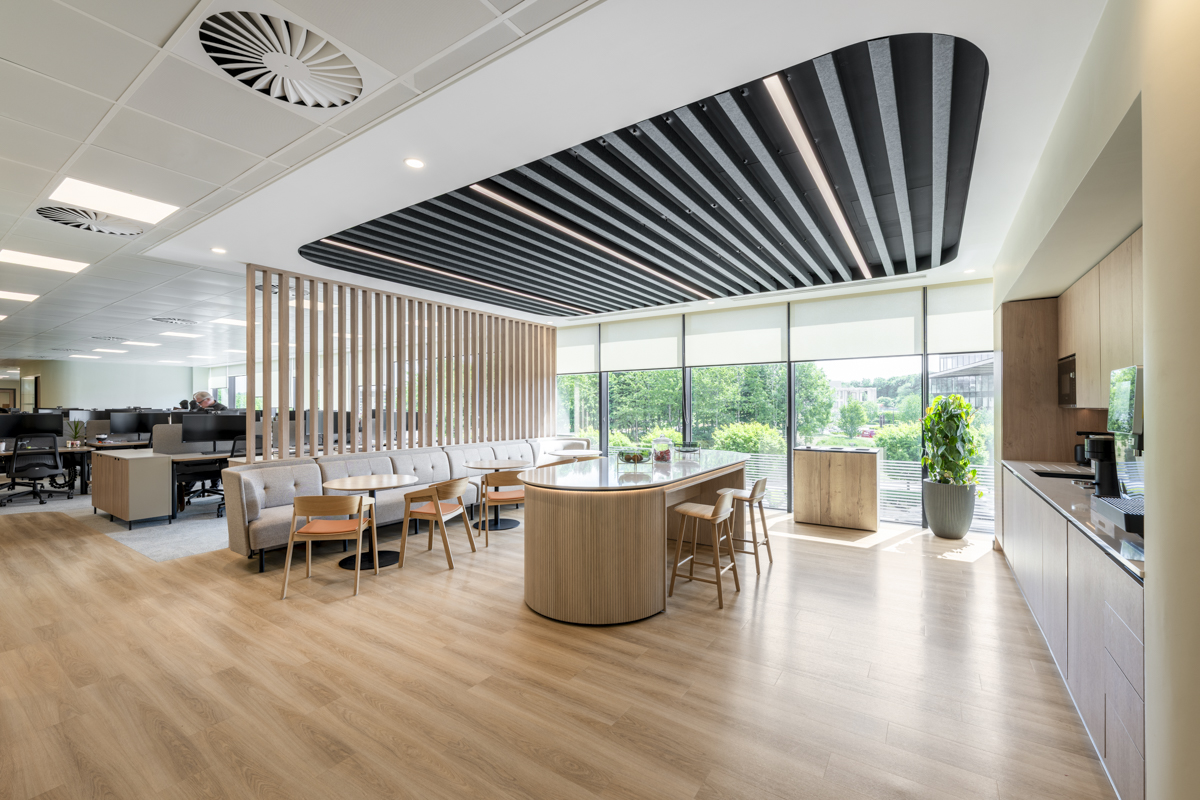
A thorough briefing process was critical to understanding how the institute’s diverse teams needed to work together day to day.
Every successful fit-out begins with a thorough understanding of what the organisation needs and why. The brief is the foundation on which every subsequent decision rests, and time invested here pays dividends throughout the project. A poorly defined brief leads to design changes, programme delays, and budget overruns that are far more expensive to resolve later.
How many people does the organisation employ today, and how is that number expected to change over the lease term? With ONS data confirming that 28% of UK working adults were hybrid working in the first quarter of 2025, and that proportion rising to 34% among full-time employees, understanding occupancy patterns has become more complex than simply counting desks. Organisations need to consider not just how many people they have, but how many will be in the building on any given day and how that varies across the week.
Operational requirements differ significantly between departments and sectors. Trading floors, client reception areas, creative studios, and back-office functions each demand different spatial configurations, acoustic treatments, and technology provision. Capturing these requirements in detail during the briefing stage ensures the design responds to genuine operational needs rather than assumptions. For organisations in financial services or professional services, where client-facing environments must project confidence and credibility, the brief should address how the workplace communicates to external visitors as well as how it functions internally. A thorough briefing process typically involves stakeholder workshops, departmental consultations, and analysis of how the current space is actually used. The output is a detailed document that guides every subsequent stage of the project.
For organisations that have not yet committed to premises, the property search is part of the briefing process. The two are closely linked because the building’s characteristics directly influence what can be achieved within it. The Central London office market in 2026 presents a distinctive challenge. Vacancy has stabilised at approximately 7.7%, according to market data compiled by Savills and Cushman & Wakefield in late 2025, but that headline figure conceals a stark divide. Demand is overwhelmingly concentrated on modern, well-specified buildings, with around 68% of take-up over the past twelve months occurring in new or comprehensively refurbished stock. Meanwhile, secondary space struggles to attract tenants even with generous incentives.
For organisations already in a building, the same principles apply when assessing whether the existing space can support the proposed fit-out. Building condition surveys should assess the state of mechanical and electrical services, the capacity of power supplies, the quality of raised floors and suspended ceilings, and any structural constraints that might affect the proposed layout. Older London buildings frequently present challenges that are not visible during a standard viewing, from inadequate electrical capacity to asbestos in ceiling voids. Engaging an office design team early in the property search allows test-fit exercises to be conducted on shortlisted spaces. These outline layouts reveal practical issues that may not be apparent from floor plans alone, such as awkward column grids, restricted floor-to-ceiling heights, or limited natural light penetration. 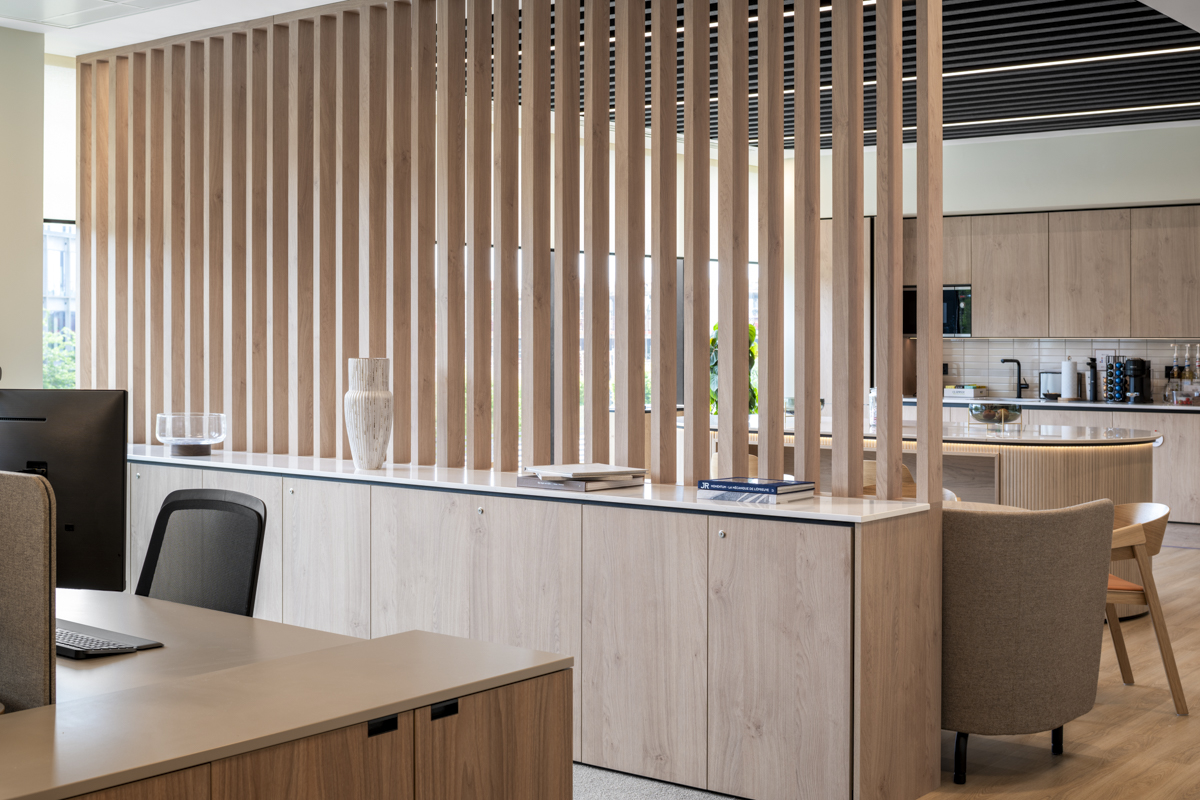
Natural materials and considered finishes at a global innovation institute’s 25,000 sq ft workspace.
The choice of delivery partner shapes the entire project experience. Organisations broadly face two routes: the traditional approach, where an architect designs the scheme and a separate contractor builds it, or a design-and-build approach, where a single party takes responsibility for both. Design-and-build typically delivers projects 30 to 40% faster than the traditional route, according to K2 Space’s own project data. For a standard 10,000 square foot Cat B fit-out, this can mean the difference between an 8 to 12 week programme and one stretching to 15 weeks or more. The efficiency comes from overlapping design and construction activities and eliminating the coordination gaps that arise when multiple independent parties are involved. Perhaps more importantly, design-and-build provides a single point of accountability. When design, fit-out, furniture, and move management sit within one team, there are no grey areas between scopes of work. Questions are answered quickly. Problems are resolved rather than passed between parties. For internal project teams, this means less time managing suppliers and more time focused on the decisions that shape the final outcome. The DTRE project at 25 Argyll Street in Mayfair illustrates this approach in practice. The 11,000 square foot scheme required coordination of specialist joinery, high-specification furniture, and sophisticated AV integration within a demanding programme. By managing all elements under a single contract, the project team delivered a workspace that achieved BREEAM Very Good accreditation while meeting the client’s exacting quality standards. 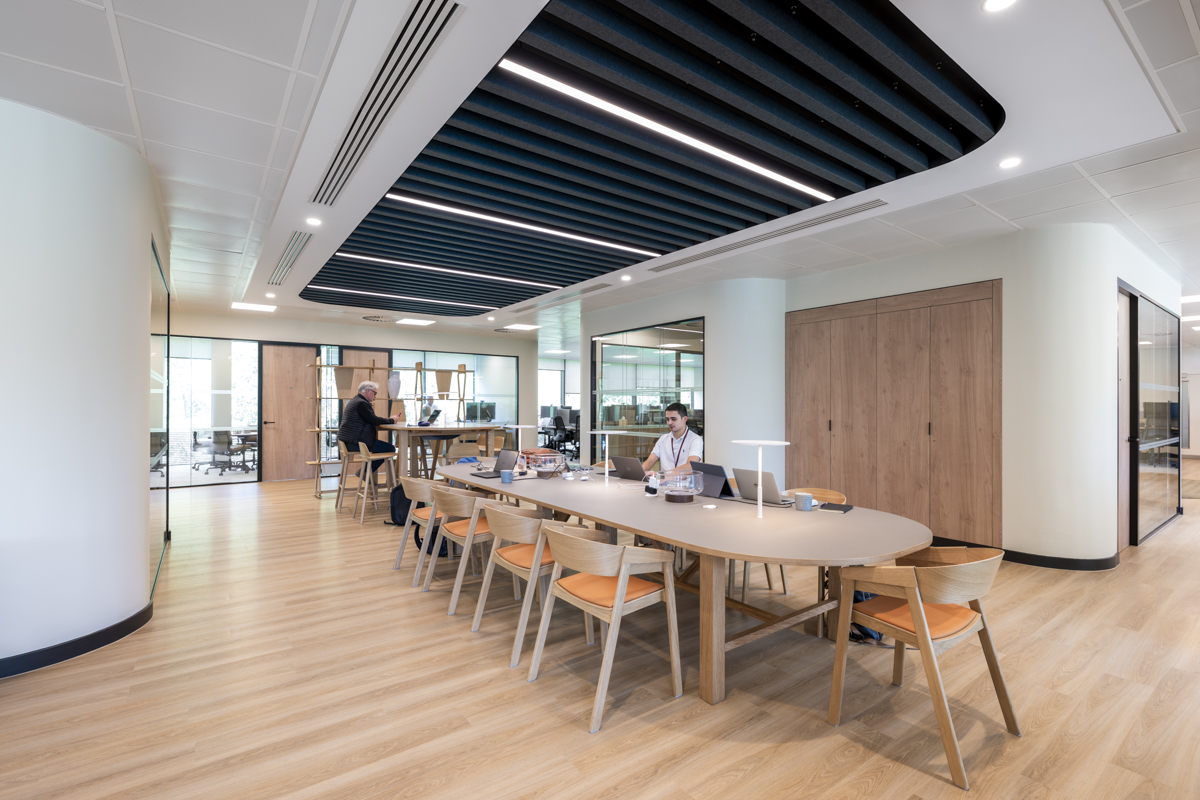
An integrated delivery partner ensures these different zone types work together as a coherent whole, rather than competing for floor area.
Space planning is the stage where strategic intentions take physical form. It determines the fundamental organisation of the floor plate, establishing where different teams sit, how circulation flows through the space, and the balance among individual workstations, meeting rooms, collaborative zones, and social areas.
Good space planning requires genuine understanding of how people work rather than assumptions or precedent. The shift toward hybrid working has changed the equation considerably. AWA’s Hybrid Working Index recorded a benchmark of around 56 desks per 100 employees in hybrid portfolios, down from close to 80 in 2022. For many organisations, this means fewer desks overall but a greater variety of work settings: focus rooms, team neighbourhoods, informal meeting points, and bookable collaboration spaces. The space plan also reveals tensions between competing requirements. Open layouts promote visibility and spontaneous interaction but can compromise concentration. Enclosed meeting rooms consume valuable floor area but are needed in significant numbers when teams coordinate with both office and remote participants. Skilled designers help organisations work through these trade-offs, developing plans that address genuine priorities without creating unintended consequences. Once the spatial strategy is agreed, concept design develops the aesthetic direction. Material palettes, colour schemes, lighting approaches, and furniture families are established, creating a coherent design language that runs through the entire workspace. Brand identity should inform these decisions without dominating them, allowing the workplace to communicate the organisation’s values through spatial quality and material choices rather than overt signage. 
This 102,000 sq ft Paris headquarters of a global tech media company required 32 manufacturers and completed installation in just four weeks.
Understanding office fit-out costs is fundamental to setting realistic expectations and making informed decisions about specification levels. In the London market, costs vary significantly depending on the scope of work, building condition, and level of finish required.
As a general framework, a standard Cat B fit-out in London typically costs between £45 and £95 per square foot for the construction works, with furniture adding a further £12 to £35 per square foot depending on specification. A good quality fit-out with ergonomic furniture and considered design detailing typically comes in at upward of £65 per square foot for the build element, with furniture costs of around £800 to £900 per person. High-specification projects for demanding occupiers can exceed these ranges significantly. These figures need to be considered alongside several variables that influence the final cost. The condition of the existing M&E services is a significant factor. If heating, ventilation, and electrical systems are outdated or insufficient, upgrading them can add materially to the budget. The presence or absence of a raised floor affects power distribution costs. Listed building constraints, common across central London, can introduce additional complexity and expense. London projects also attract a premium of 15 to 25% over regional markets due to higher labour costs, congestion, and building access restrictions. Contingency allowances should be built into every budget. A figure of 5 to 10% of the construction cost is typical, providing a buffer for unforeseen issues that emerge during the build. Older buildings are particularly prone to surprises, from hidden structural issues to contaminated materials that require specialist removal. We saw this first hand during the conversion of a 1930s former bank into an investment firm’s London headquarters. The 2,496 square foot project required careful cost management around heritage elements, including the retention of the original vault door, while still delivering a workspace that met the operational and aesthetic standards expected by a modern financial services firm. In period buildings like this, contingency provisions are not optional but essential. 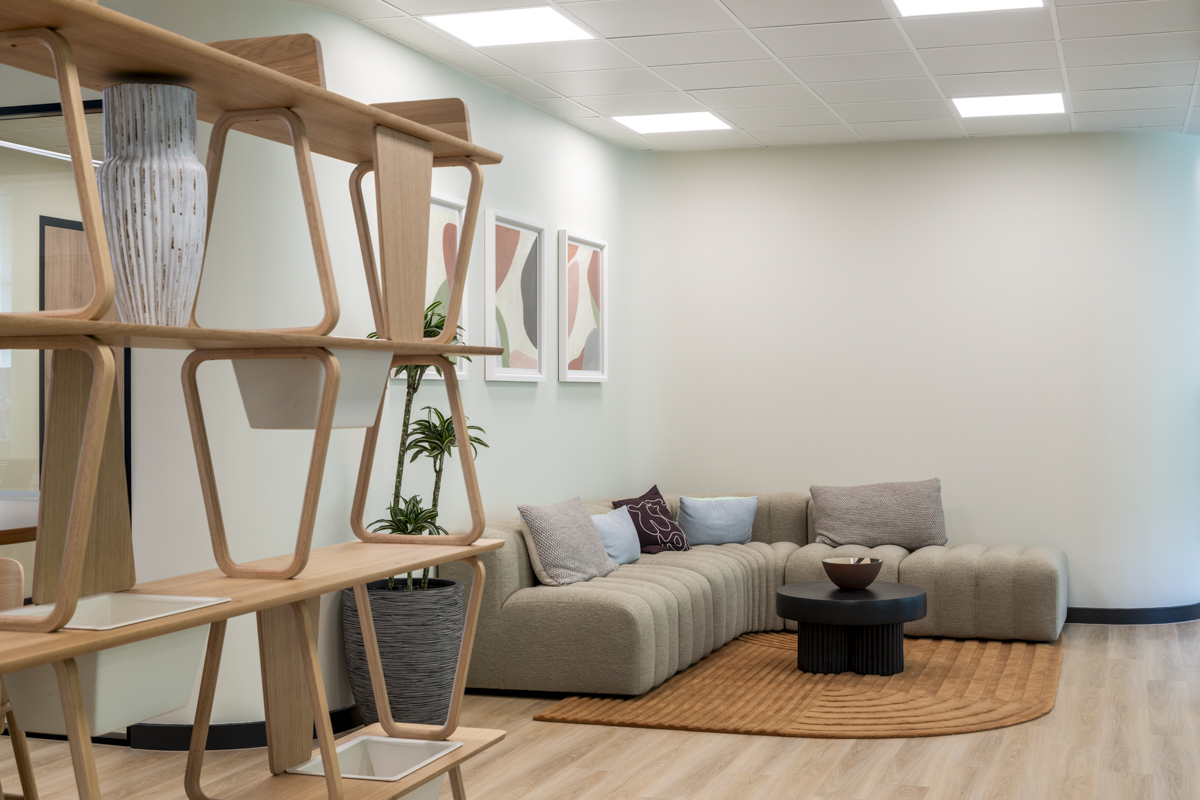
With concept design approved and budget established, the project moves into detailed design. At this stage, every element of the fit-out is specified precisely enough to be priced, procured, and built. Drawings are developed to a level of detail that removes ambiguity for contractors and suppliers. Technical drawings include reflected ceiling plans showing lighting layouts and acoustic treatments, power and data distribution plans, HVAC modification drawings, and partition layout plans with door schedules and ironmongery specifications. Each of these must be coordinated to ensure that services do not conflict with each other or with the architectural design intent.
Material schedules specify every finish in the project, from flooring types and wall treatments to worktop materials and paint colours. These schedules reference specific products with manufacturer codes, ensuring that what is ordered matches what was designed. For organisations pursuing BREEAM or SKA accreditation, material selections need to meet specific environmental criteria around embodied carbon, VOC emissions, and responsible sourcing. Landlord approvals represent a potential bottleneck at this stage. Most commercial leases require the landlord to approve fit-out works through a licence to alter. This process can take several weeks and may require technical submissions, structural calculations, or fire strategy reviews depending on the scope of work. Building the approval process into the programme from the outset prevents it from becoming a source of delay. 
Workstations within a listed Hôtel Particulier. Detailed specification at this stage ensured that every product met both the design intent and the building’s heritage constraints.
Furniture represents a significant proportion of overall project cost and has a direct impact on how the workplace functions and feels. Unlike built elements of the fit-out, furniture is what people interact with every day. The quality of task chairs, the functionality of desking, and the comfort of meeting room seating all affect productivity, wellbeing, and satisfaction. The selection process should begin during design development, because furniture dimensions influence spatial planning. A desking system with integrated storage has different planning implications from one without. Task chairs vary in their space requirements when reclined. Understanding these constraints early prevents costly layout revisions later in the programme.
Ergonomics should be a primary consideration. Ergonomic office furniture, including adjustable task chairs, height-adjustable desks, and properly positioned monitor arms, protects employee health and supports sustained productivity. The investment in quality ergonomic products typically pays for itself through reduced absenteeism and improved performance. Furniture consultancy services help organisations make sense of a complex market. An experienced consultant brings knowledge of manufacturers, products, and price points alongside the project management capability needed to coordinate procurement, delivery scheduling, and installation. Warehousing capabilities provide additional flexibility, allowing furniture to be received, inspected, and stored off-site until each area of the fit-out is ready to receive it. This prevents congestion during the final stages of construction and protects products from damage. During K2 Space’s work with Latham & Watkins across offices in Manchester, London, and Brussels, furniture consultancy and FF&E procurement were managed as an integrated part of the wider project. Coordinating sit-stand workstations and specialist seating across multiple locations required detailed logistics planning and close communication with manufacturers to ensure consistent quality and timely delivery. The multi-site nature of the programme meant that each location had its own access constraints, delivery windows, and installation sequences, all of which had to be managed within a single procurement framework. 
DTRE’s 11,000 sq ft Mayfair workspace, which achieved BREEAM Very Good accreditation and won a sustainable design award.
Sustainability has moved from a peripheral consideration to a central element of fit-out planning. Savills reported that 64% of Central London take-up in 2024 occurred in BREEAM Excellent or Outstanding rated buildings, a figure that underlines the extent to which environmental credentials now influence leasing decisions. For occupiers, the fit-out itself presents an opportunity to demonstrate genuine commitment to sustainability through the choices made about materials, energy, and waste. Organisations pursuing formal accreditation through BREEAM Refurbishment and Fit-Out or the SKA rating scheme need to engage with the assessment process early. Both frameworks have timing requirements, particularly around design-stage evidence, that make retrospective compliance difficult and expensive. A BREEAM assessor should be appointed at the start of design development, with target credits agreed and responsibilities allocated across the project team. Even for projects not pursuing formal certification, sustainable design principles should inform material selections and construction practices. Specifying carpets made from recycled content, paints with low VOC emissions, and timber from responsibly managed forests are straightforward measures that reduce environmental impact without adding significantly to cost. Designing for adaptability, so that the workspace can be reconfigured as needs change without wholesale replacement of materials, extends the useful life of the fit-out and reduces long-term waste. 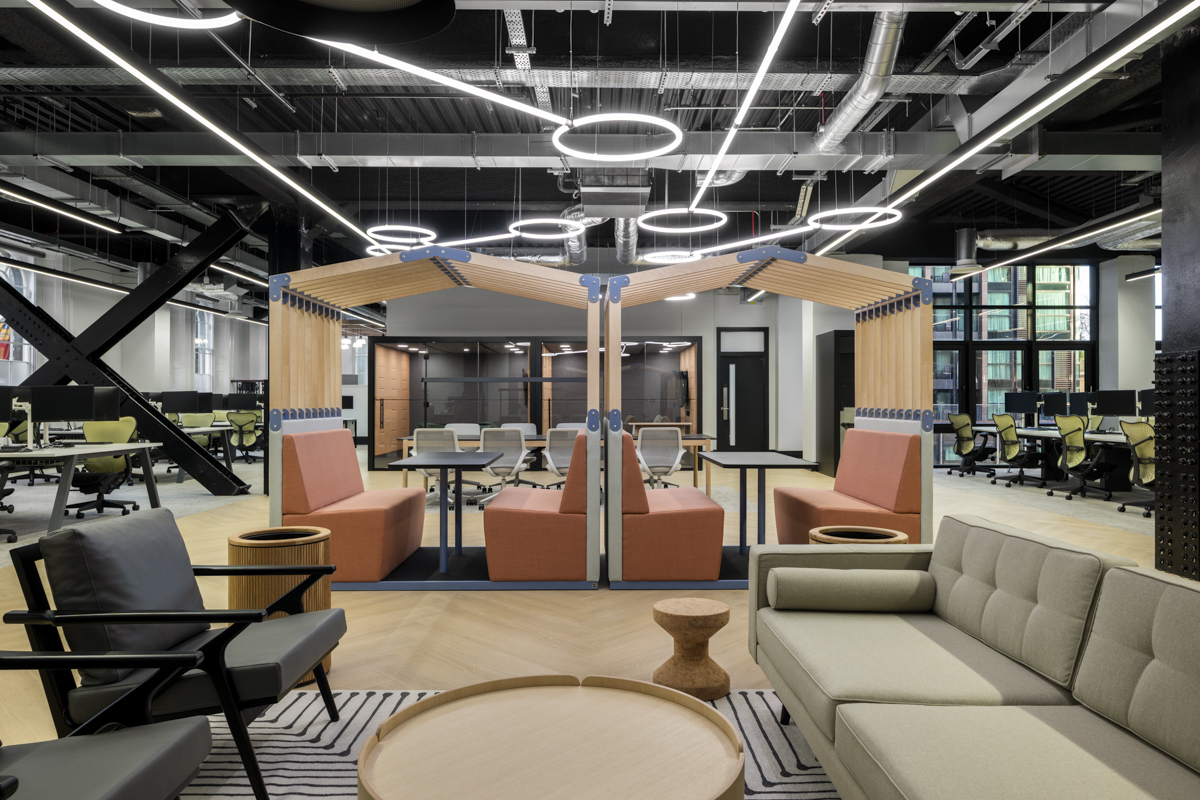
The construction phase transforms design intent into physical reality. For a standard 10,000 square foot Cat B fit-out, the on-site programme typically runs between 8 and 14 weeks, though larger or more complex projects can extend to six months or more. The design-and-build route typically compresses this timeline by allowing design resolution to continue in parallel with early construction activities such as strip-out and first-fix M&E works. We have seen compressed delivery programmes succeed repeatedly when the team structure is right. Genetec’s 6,000 sq ft London W1 office was delivered in just eight weeks within a period building, while OSRL’s 6,000 sq ft Southampton workspace was completed in the same timeframe. Both projects demanded tight coordination between trades and early resolution of specification details to avoid any slack in the programme.
Programme management keeps the project on track. A detailed programme identifies every activity, its duration, and its dependencies. Regular progress reviews against this programme allow potential delays to be identified early and addressed before they cascade through the schedule. For organisations with fixed move dates, whether driven by lease expiries or business requirements, programme certainty is paramount. Quality control runs throughout the construction period. Regular site inspections, material sample approvals, and milestone sign-offs ensure that work meets specification. Mock-ups of key details, such as feature joinery or reception desks, allow the design team and the client to review quality before full-scale installation begins. This investment in early validation avoids the cost and disruption of rectification later. Health and safety responsibilities must be clearly defined from the outset. When multiple trades are working simultaneously, clear protocols for site access, personal protective equipment, and emergency procedures protect everyone involved. The principal contractor carries primary responsibility, but all parties on site must understand and comply with the safety requirements.
Workplace technology planning should run in parallel with the design and construction programme rather than being treated as a separate workstream addressed at the end. Network infrastructure, structured cabling, AV systems, and access control all require coordination with the wider fit-out to ensure that containment routes, power provisions, and spatial allocations are designed in from the start. Structured cabling forms the backbone of the workplace technology environment. Cat6A cabling is now the standard for new installations, providing the bandwidth needed for current and anticipated future applications. Cable routes need to be planned in detail, with sufficient capacity for both data and voice requirements and appropriate separation from power cables to avoid interference.
Meeting room technology has become more complex in the era of hybrid working. Rooms need to support video conferencing at a quality level that allows remote participants to engage as effectively as those physically present. This requires considered placement of cameras, microphones, and displays, along with acoustic treatment that prevents echo and background noise from degrading the experience for remote attendees. For organisations in sectors such as financial services, where IT infrastructure is mission-critical, parallel running arrangements may be needed to ensure continuity during the transition. This involves maintaining both old and new technology environments simultaneously for a period, allowing systems to be tested under real-world conditions before the old infrastructure is decommissioned. 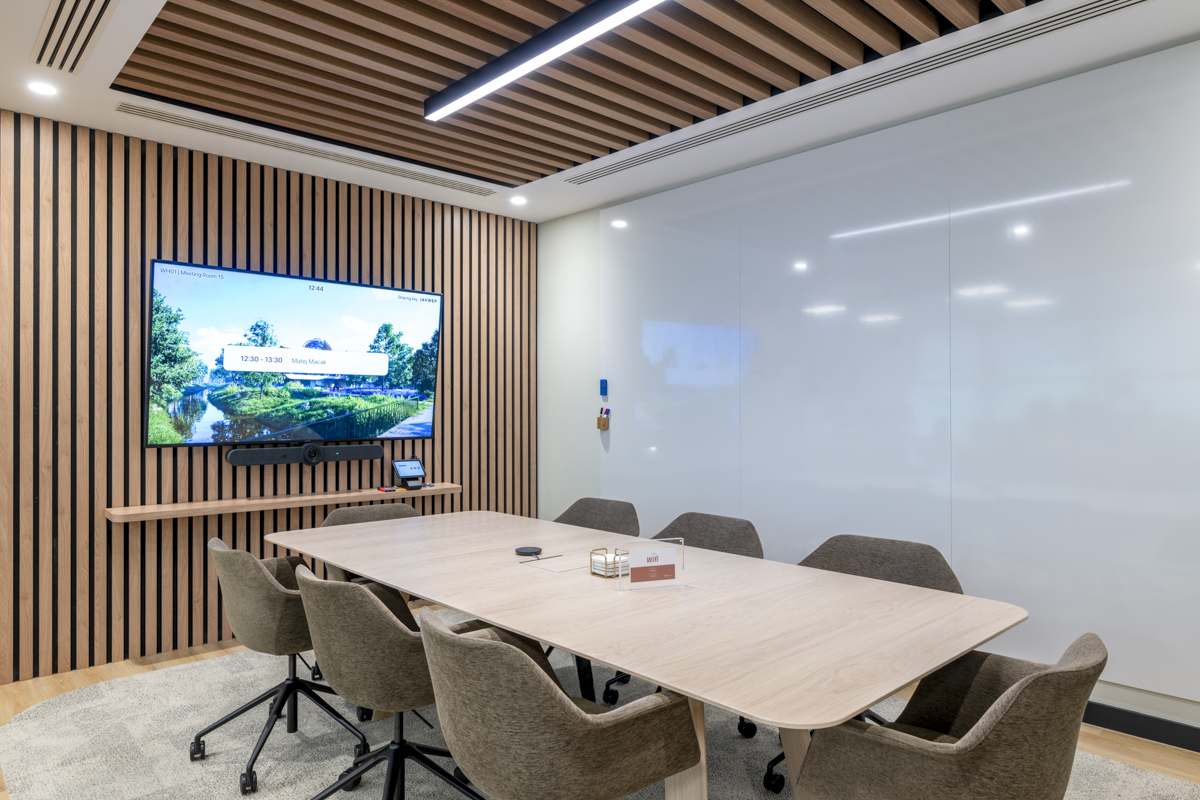
The final weeks before handover are among the most intensive in the project. Snagging walks identify items requiring rectification, from paint touch-ups and alignment adjustments to more substantive issues with mechanical or electrical installations. A systematic approach to snagging, using detailed room-by-room schedules, ensures that nothing is overlooked and that the contractor has clear instructions for rectification. Commissioning of building services verifies that HVAC systems, lighting controls, fire alarms, and security systems are all functioning correctly. This testing should be conducted before furniture installation begins, so that any issues can be resolved without disrupting the final stages of the project. Air handling systems in particular need to be balanced and tested to ensure that temperature and ventilation meet design specifications across all areas of the floor plate.
Building compliance documentation should be assembled and reviewed before handover. This includes fire risk assessments, electrical test certificates, building control sign-off, and any documentation required under the licence to alter. For projects with BREEAM or SKA accreditation, post-construction evidence needs to be compiled for the assessor. Ensuring all documentation is complete before the move prevents compliance issues from emerging after occupation. The office relocation checklist provides a comprehensive framework for the handover period, covering everything from final inspections through to building orientation for staff. Working through each element systematically ensures a controlled transition from construction site to functioning workplace.
The end of the fit-out is not the end of the project. The weeks and months following occupation reveal how the workplace performs under real-world conditions, and this learning should be captured and acted upon. Defects management continues after handover. Most fit-out contracts include a defects liability period, typically twelve months, during which the contractor is obligated to remedy any problems that emerge. Establishing clear reporting processes ensures that issues are logged, tracked, and resolved promptly rather than accumulating as a source of frustration.
Space utilisation monitoring provides data on how the workplace is actually being used. Are meeting rooms being booked as expected? Are quiet zones providing the focus environment they were designed for? Are collaborative spaces supporting the interactions they were intended to encourage? This information guides adjustments to layouts, booking policies, or operational procedures that help the space work better. Sensors and booking system data can provide objective evidence to supplement anecdotal feedback. A formal post-occupancy evaluation, conducted three to six months after the move, provides a structured assessment of how well the new workplace meets its intended objectives. The findings inform future projects and help the organisation understand the return on its investment. For the workplace experience to evolve and improve over time, this kind of systematic feedback is invaluable.
An office fit-out involves hundreds of interdependent decisions, each with the potential to affect cost, programme, and quality. When these decisions are managed across multiple independent parties, the burden of coordination falls on internal teams who may already be stretched by their day-to-day responsibilities. An integrated design-and-build partner changes this dynamic by bringing design, construction, FF&E procurement, and move management under a single contract. The result is that coordination becomes internal rather than external. Design decisions are made with full awareness of their construction and cost implications. Programmes are developed holistically. When issues arise, they are resolved within the team rather than escalated between parties. For organisations managing complex fit-outs in demanding London environments, this integration provides both commercial certainty and operational confidence.
K2 Space has delivered workplace transformations across London since 2004, working with organisations from global financial institutions to growing technology firms. Our integrated approach brings together design, fit-out, furniture, and move management under a single team with a defined timeline and a fixed budget. For organisations planning a fit-out in 2026, this experience provides confidence that every stage of the process will be managed with the same rigour and attention to detail as the finished workplace itself.
To discuss your fit-out requirements, contact our team or request an initial cost estimate to begin the conversation.